Find of the Week — how it works and how to be chosen
DetectID's Find of the Week is editorial, not algorithmic. This is how a find gets picked, what makes one stand out, and how to put yours in contention.
Every Monday morning, one publicly-shared find on DetectID gets the Find of the Week slot on the homepage hero. Here’s how it’s picked, what gets it noticed, and how to put yourself in contention.
Where it appears
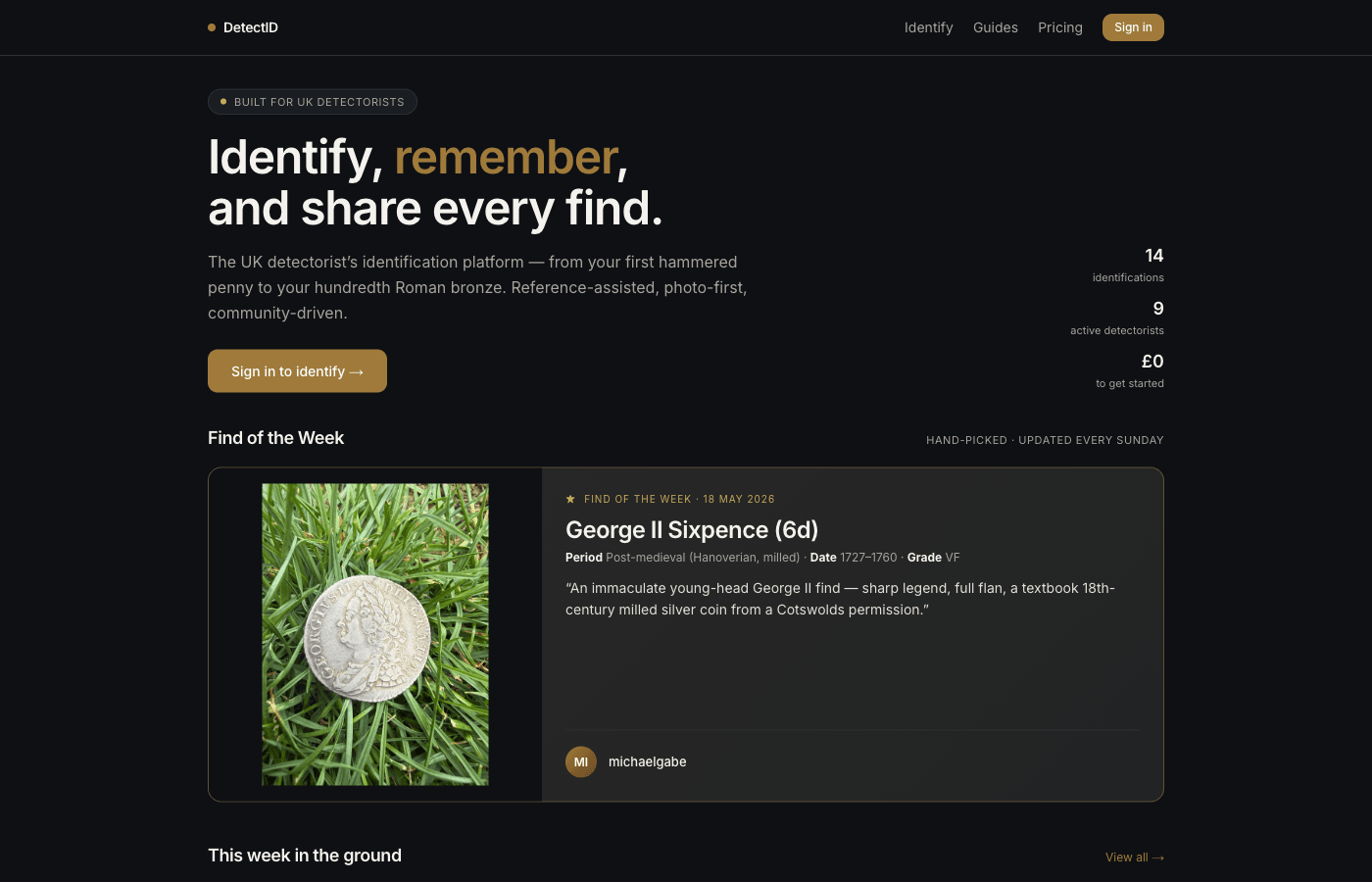
Find of the Week sits at the top of the DetectID homepage, just below the hero. Anyone visiting app.detectid.co.uk— signed in or not — sees it. The find shows its photo, the identification, the period and date range, a brief curator’s note about why it was chosen, and a click-through to the finder’s public profile.
It runs from Monday to Sunday in the UK time zone. A new pick goes live every Monday morning.
How a find gets selected
The DetectID team browses recently-shared public finds each week and chooses one. It’s editorial, not algorithmic. There’s no submission process and no leaderboard auto-promotion — sometimes the chosen find has many hearts, sometimes it has almost none. The criteria below are what we look for.
Visual interest
A well-photographed find on a clean background, with the diagnostic detail visible. Clarity matters more than artistry — a sharp, even-lit photo of a worn coin beats a blurry photo of a perfect one.
A story we can tell
Finds that have something to teach the community get priority. A textbook example of a famous coinage; an unusually well-preserved version of a typically-worn issue; a find that fits the season (a Tudor sixpence around Easter, a Roman dolphin brooch in summer when Roman material features); a find that illustrates a recent guide on the site.
A clear identification
Finds with a confident DetectID verdict and a complete reasoning chain make for better featured posts. Indeterminate-ruler finds rarely get featured — not because they’re uninteresting, but because the curator’s note has less to anchor against.
Range across periods
Over a year we try to feature finds across the periods UK detectorists work in: Roman, Anglo-Saxon, Medieval, Tudor, Stuart, Georgian, Victorian. If three consecutive weeks have been medieval hammered silver, the fourth is more likely to be Roman or Georgian.
How to put your find in contention
- Share it publicly.Only public finds are eligible. Toggle Share on the find’s detail page (see our sharing finds walkthrough).
- Photograph it well. Clean background, diffuse light, both sides if your plan allows. See photographing finds for identification.
- Identify it confidently.Give the engine everything you know — weight, region, notes. A high or medium confidence verdict with a complete reasoning chain travels better.
- Add a useful public note when sharing.One or two sentences about the find — the find spot context, how it cleaned up, what surprised you. The curator’s note often pulls phrases from these.
- Set a sensible attribution.Your public username gets the credit. If you’ve set one up properly (see building your public profile), the click-through from FOTW lands on a well-presented page.
What doesn’t affect selection
- Your plan tier — Free, Basic, and Premium are equally eligible. (Free can’t share, so practically Free isn’t in contention — but if you upgrade to Basic for the share toggle, you’re in.)
- Heart count — we don’t weight by hearts.
- Whether you’re a Rally Captain.
- How long you’ve been on the platform.
- Whether you’ve been featured before. Repeat features happen if the find warrants it.
What happens when you get featured
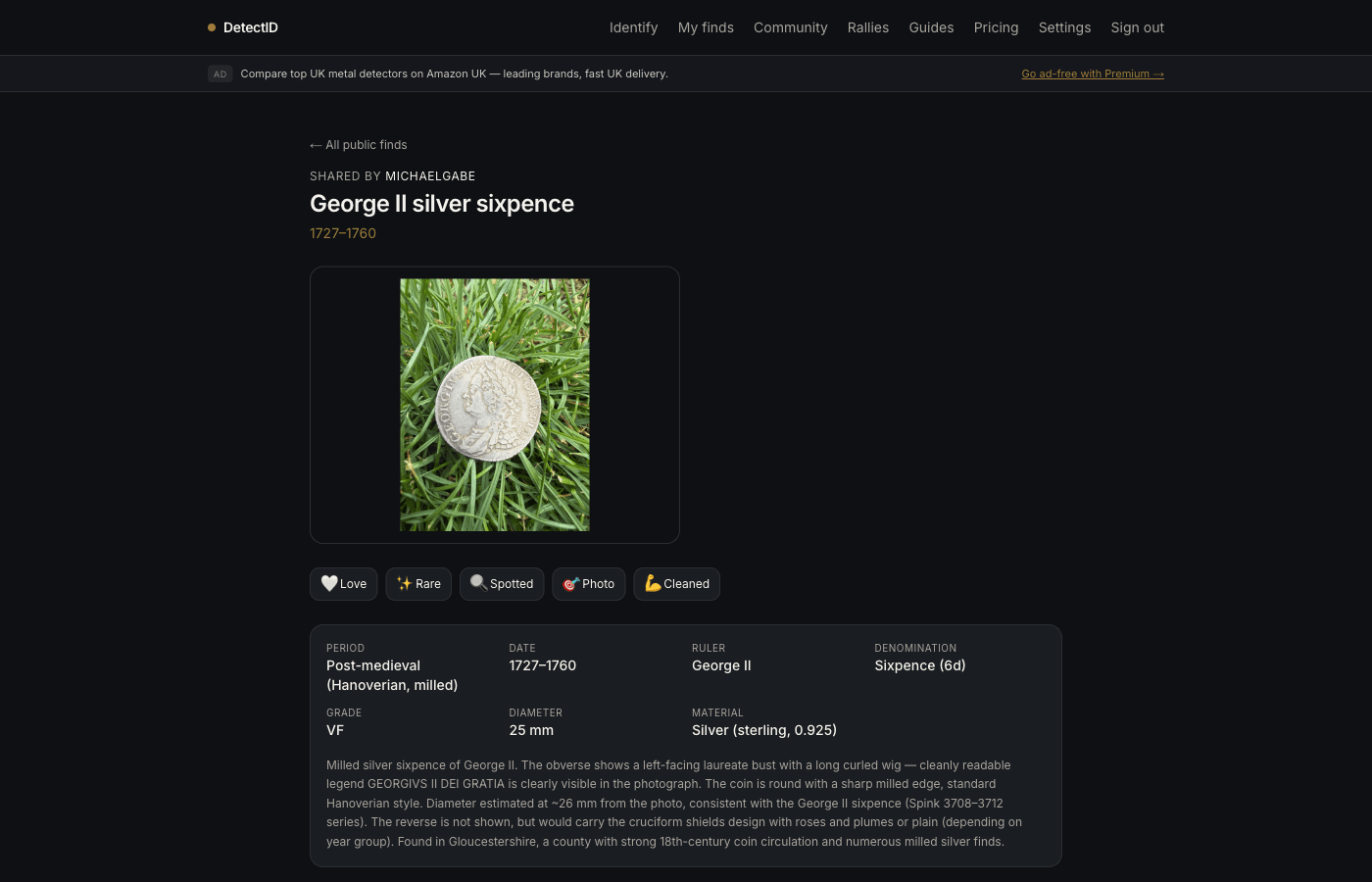
We’ll email you the morning we make the choice. The find is featured for seven days, gets significant homepage visibility, and tends to attract hearts and comments. Some featured detectorists report it being a good week for their public profile traffic.
If you’d rather not be featured (private reasons, permission anonymity), let us know via the find’s contact-finder option and we’ll respect that.
The Find of the Week archive
Past Find of the Week selections are archived and viewable from the homepage (look for the small “archive” link beneath the current featured find). Useful as a record of what the community has been bringing up, and as a steady source of well-photographed example finds.
Common questions
Can I submit my find for consideration?
There’s no submission form. Sharing publicly puts you in contention; we browse the public feed each week. If you’d like a feature to coincide with a club AGM or media moment, let us know via the in-app feedback — we can’t promise but we can pay attention.
How many times can I be featured?
No cap. Particularly active detectorists with consistently good finds get featured several times a year.
Can I see all my features?
Your public profile shows a small “featured” ribbon on any find that’s been Find of the Week. Past features remain accessible from the homepage archive link.
Does the engine’s verdict need to be right for selection?
Confident, yes. Provably correct, no — we don’t re-identify the find before featuring. If a featured find turns out to have been mis-identified, we update the post and the public find together.
Next steps
- Sharing your finds: Sharing finds publicly.
- Public-profile setup: Building your public profile.
- Photography for shareable finds: Photographing finds for identification.
Try DetectID on a real find
Upload a photo and we’ll return a calibrated shortlist with period, denomination, ruler and full reasoning chain.
Identify a find