Reporting your finds to the Portable Antiquities Scheme
Step-by-step guide to recording UK detecting finds with your local Finds Liaison Officer — what to record, how to contact them, and how DetectID helps.
The Portable Antiquities Scheme is the voluntary recording system for archaeological objects found by the public in England and Wales. Reporting your finds is one of the most important things a responsible detectorist can do — here’s exactly how, and why it matters more than people realise.
Why record finds at all?
Three reasons:
- Archaeological context. A solitary Edward I penny in a field is interesting. Fifty Edward I pennies recorded over a decade in the same parish becomesevidence— of a market, of a hoard, of a settlement we didn’t know was there.
- Hobby legitimacy. The PAS exists because the detecting community pushed for a voluntary system that respected the right to detect on permitted land while protecting the archaeological record. Every find recorded strengthens the political case for detecting.
- Future-you. Your records become a permanent, searchable archive. Twenty years on, your great-grandchildren can look up your finds on finds.org.uk and see what you found and where.
The PAS database in a sentence
Operated by the British Museum. Open to the public. Free to use. Searchable at finds.org.uk. Every recorded find gets a unique reference (e.g. SOMDC-D47921) plus images, measurements, identification, and (at the discretion of the finder) a four-figure or six-figure grid reference for the find spot.
Who’s a Finds Liaison Officer?
Each region of England and Wales has at least one FLO — usually employed by a county museum or council. They’re professional archaeologists whose specific remit is to record public finds. They’re friendly, knowledgeable, and genuinely interested in seeing what you’ve found.
Find your local FLO atfinds.org.uk/contacts. Most counties have an email and a phone number; many also have regular “finds days” where you can drop in with a bag of finds and have them recorded on the spot.
What to record
Officially recordable categories:
- Coins of any period.
- Metal artefacts older than 1700 (brooches, buckles, mounts, weights, tokens).
- Worked flint and stone tools.
- Pottery sherds with diagnostic features.
- Anything that looks like it might be archaeologically significant — let the FLO decide if it’s recordable.
Not recordable:
- Modern junk (lead shot, ring-pulls, post-1700 buttons without specific provenance).
- Coins minted after 1700 unless they’re of specific local interest.
- Unprovenanced finds (no find spot).
Step-by-step: recording your first find
- Identify your local FLO. Visit finds.org.uk/contactsand search by county.
- Email them with a photo and a description.Keep it brief: “Hi, I’m a detectorist and I’ve found a [thing] near [parish]. Attached is a photo. Could you have a look and tell me whether you’d like to record it?”
- Have your find-spot information ready. The minimum is a four-figure grid reference (a 1 km square) and you can choose to share a six-figure (100 m square) if you trust the FLO and want the record more useful. A What3Words location can also work if the FLO accepts it.
- Hand-in or post. Most FLOs ask you to bring the find in person so they can examine it. Some accept finds by post in pre-arranged cases.
- Wait for the record.The FLO writes up the find, allocates a reference number, and uploads it to the database. You’ll get a copy of the record by email.
- Get your find back.Recording is non-destructive — the find returns to you. The FLO photographs and measures it during the recording process; they don’t keep it.
What DetectID puts in front of you
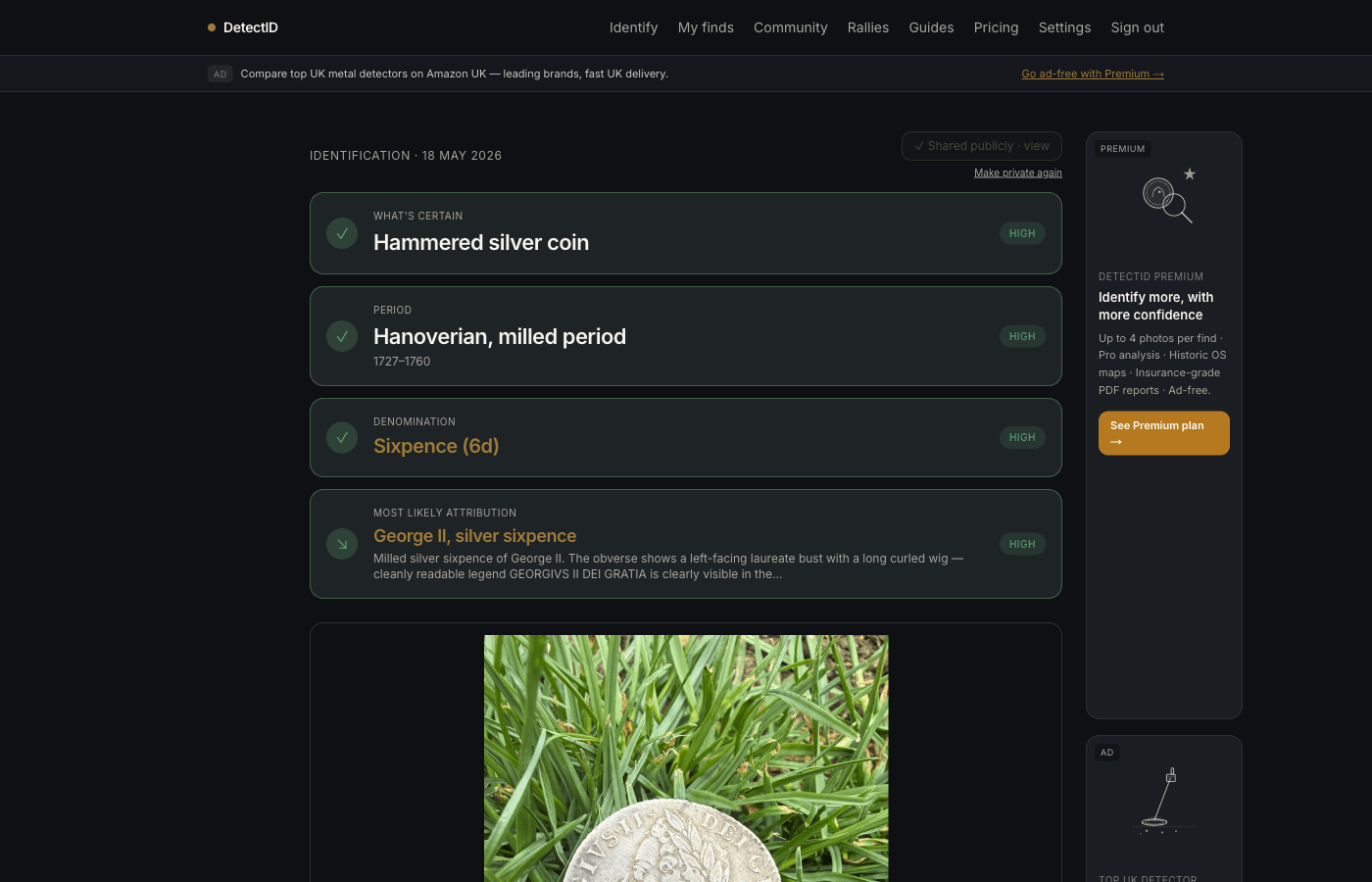
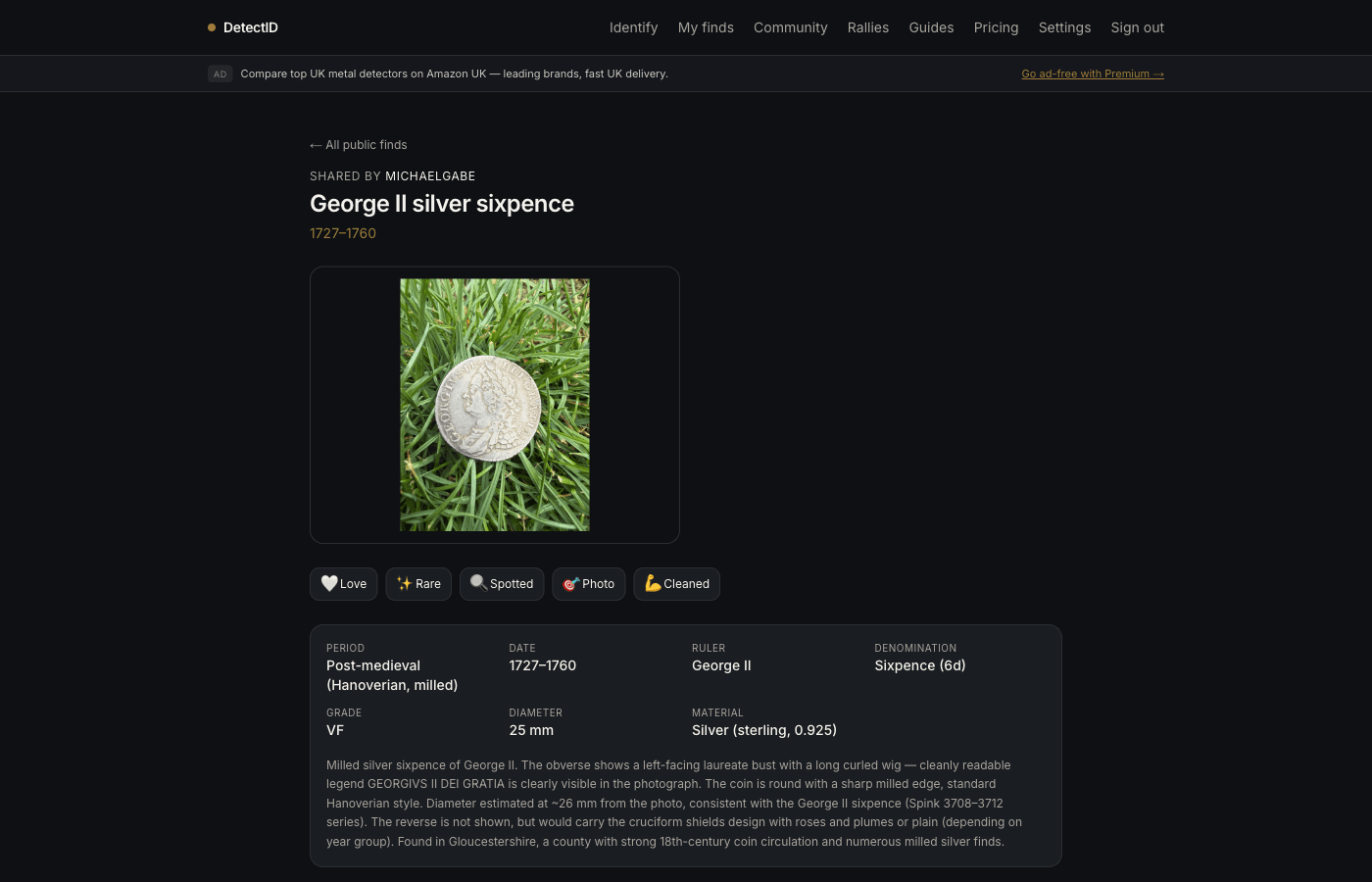
The DetectID identification you got is genuinely useful to the FLO. Forward the result-page URL with your initial email and you save them 80% of the writeup time. The engine’s reasoning chain matches the diagnostic logic the FLO would apply — it’s the same methodology, just faster.
The Treasure Act — when reporting is legally required
Most finds are voluntarily recorded. Some are legally requiredto be reported. The Treasure Act 1996 covers gold or silver objects 300+ years old, associated groups of objects, prehistoric base-metal hoards, and certain object categories. If the DetectID engine flags your find with a Treasure Act flag, contact your FLO promptly — the 14-day reporting window starts when you realised the find may meet the criteria.
Full detail in our Treasure Act flag walkthrough.
Grid references — how precise to be
Tradeoffs:
- Four-figure (1 km square). Privacy-friendly. Adequate for the record to contribute to broad spatial patterns. Acceptable to most FLOs.
- Six-figure (100 m square).Much more useful archaeologically — allows finds to be plotted at parish scale. Slightly more sensitive: still doesn’t identify the field, but a neighbour could narrow it down with effort.
- Eight-figure or ten-figure (10 m / 1 m).Pinpoint accuracy. Useful for the FLO to map the find against known archaeological features. Only share with a trusted FLO and only for very significant finds.
Default to four-figure unless the find or the FLO warrants more. You can’t un-record a grid reference later.
If your FLO is hard to reach
FLOs are sometimes thin on the ground — one or two for an entire county, often part-time. Don’t take silence as rejection.
- Allow two weeks for an email reply.
- If no reply, follow up politely.
- Some FLOs prefer phone or in-person. Try the listed phone number.
- If your FLO is genuinely unresponsive, contact the national PAS office at finds.org.uk/contacts/headoffice.
The honest reality of PAS reporting
Not every detectorist records every find. Modern junk gets binned; recent coppers go on the kitchen-shelf-of-shame. The realistic bar is: anything that’s pre-1700, anything precious metal, anything that looks unusual. If you record one in three of those, you’re doing more than most detectorists.
Useful links
- finds.org.uk — the PAS database, public search.
- finds.org.uk/contacts — find your local FLO.
- The Treasure Act 1996 in plain English — our reference guide.
- The Treasure Act flag walkthrough — what to do when the engine flags a find.
Next steps
- Getting better identifications to forward to your FLO: How to identify your first find.
- Photographing for the FLO record: Photographing finds for identification.
Try DetectID on a real find
Upload a photo and we’ll return a calibrated shortlist with period, denomination, ruler and full reasoning chain.
Identify a find