The Treasure Act flag — what it means and what to do
When DetectID raises a Treasure Act flag on a find, what the 1996 Act actually requires, and the right next steps with your Finds Liaison Officer.
Some of the finds DetectID identifies will come back with a Treasure Act flag. That doesn’t mean the find isTreasure under the 1996 Act — it means the engine thinks the criteria are worth checking. Here’s what the flag means, what it doesn’t, and what to do next.
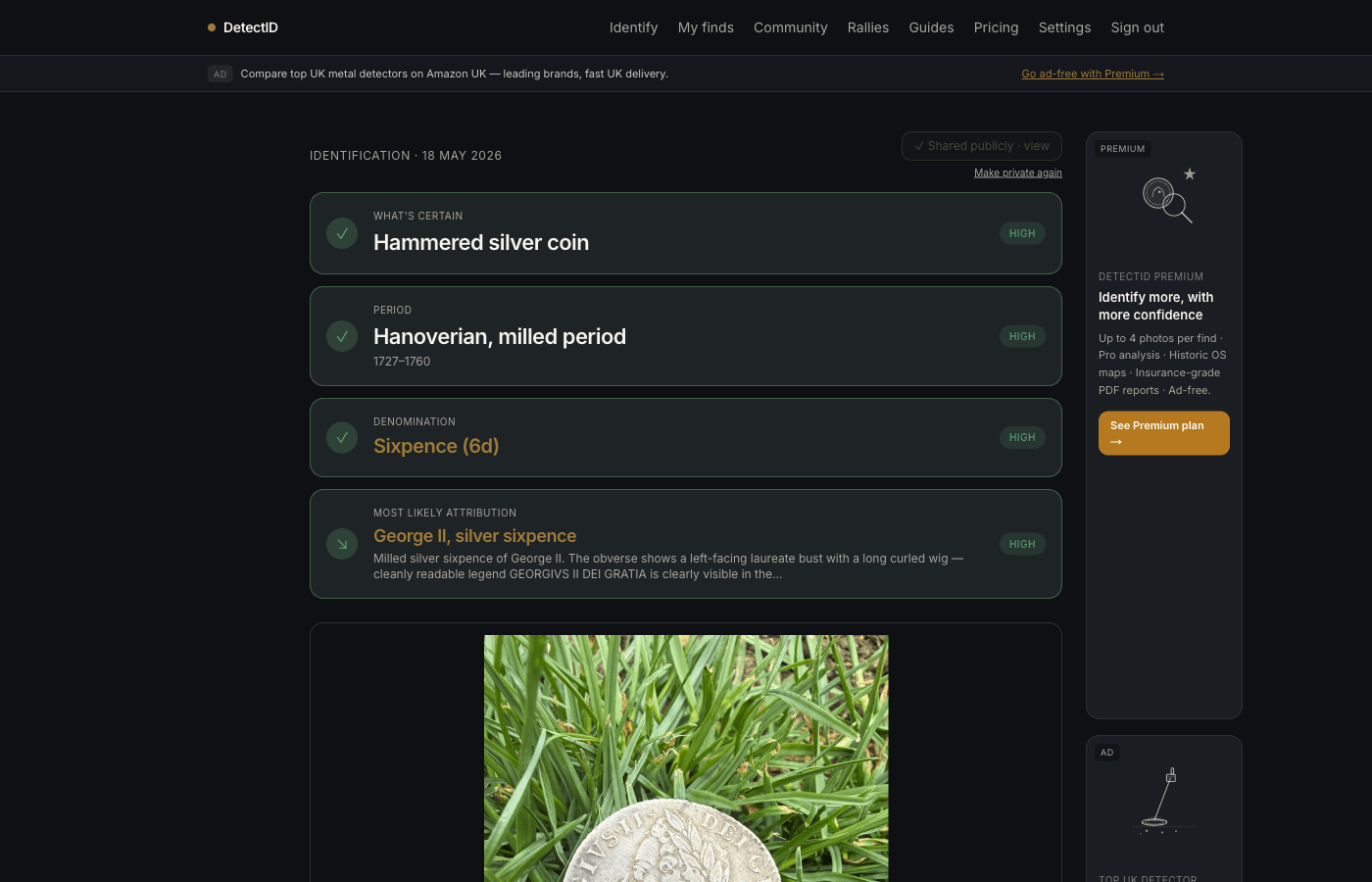
The headline
The Treasure Act flag is a suggestion, not a directive. We never report finds on your behalf. The flag is the engine raising its hand to say “this looks like it might need to go through the proper process”, and the rest is between you, your Finds Liaison Officer, and the Coroner.
What is the Treasure Act 1996?
The Treasure Act 1996 is the UK law that defines what counts as Treasure and what a finder is legally obliged to do about it. In a sentence: certain categories of find must be reported to the Coroner via your local FLO within 14 days of realising you may have a Treasure-eligible find.
The headline categories (much-simplified — consult the Act or your FLO for the full list):
- Any object of any age made substantially of gold or silver, found in association with another gold or silver object (i.e. as a group / hoard).
- Objects 300+ years old made of 10% gold or silverby weight, found as a hoard of two or more.
- Pre-historic finds of base-metal in associated groups (since 2003).
- Objects 300+ years old of any material found at the same time and place as Treasure (associated finds).
- A single coin can be Treasure if it’s part of a hoard (i.e. associated with other coins or objects at the same find spot, even if recovered separately over time).
What a single silver coin is — and isn’t
A single silver coin found alone is notautomatically Treasure. This catches people out because the Act’s shorthand makes it sound like it would be.
The Act requires association — a group of two or more, or an object found alongside Treasure. A solitary Edward I penny in a field with no other associated finds is not Treasure under the Act. It’s a great find and you should record it with the Portable Antiquities Scheme, but it’s not legally Treasure.
Where the engine will flag a single silver coin: when there are contextual reasons it may be part of an unrecorded hoard (e.g. you’ve noted similar coins were found nearby, or the find spot has historical hoard records).
When the engine raises the flag
DetectID flags a find as potentially Treasure-eligible when one or more of these is true:
- The find is described as part of a group / hoard in your notes.
- The material is precious metal (gold, gilt, silver) AND the find is part of an associated assemblage.
- The object category falls within prehistoric base-metal groups (post-2003 amendment).
- The find type (e.g. early-medieval gold ornament fragment) has a clear pattern of historic Treasure case-law.
Importantly, the flag is calibrated to over-flagrather than under-flag. A false positive (a flag that doesn’t end up being Treasure) is fine — you call your FLO, they confirm it’s not, no harm done. A false negative (Treasure that wasn’t flagged) could land you in legal trouble. So we err on the side of asking.
What to do if you see a flag
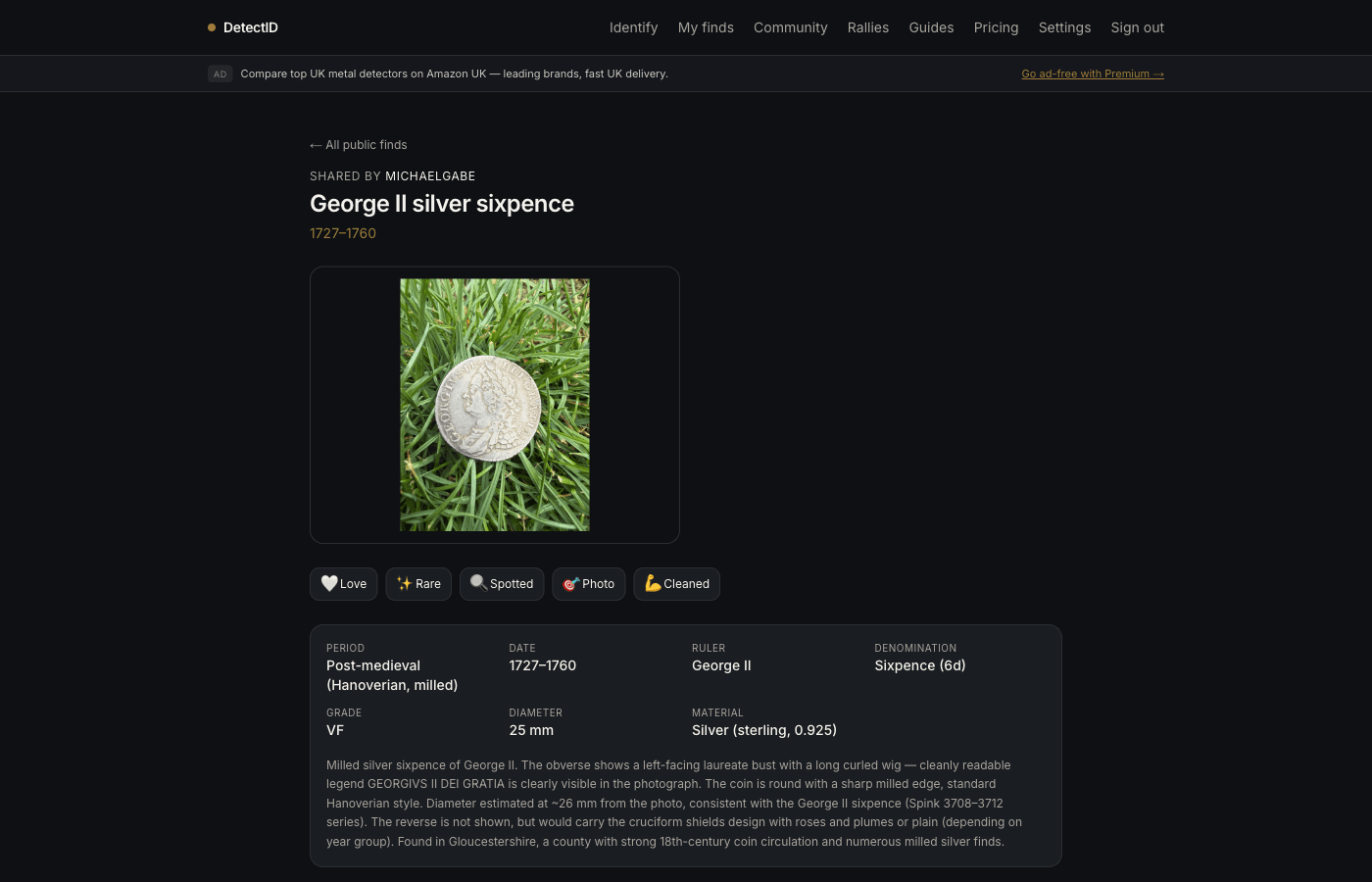
- Don’t panic.The flag isn’t an allegation. It’s a heads-up to follow the proper process.
- Read the engine’s explanationbeside the flag. It will say why it raised the flag — usually one or two specific features that triggered the criteria.
- Contact your local Finds Liaison Officer. The PAS website at finds.org.ukhas a search by county or postcode. Your FLO is the first stop — they’ll confirm whether the find is Treasure under the Act.
- Record the find on the PAS databaseregardless of whether it’s declared Treasure. Recording is free, voluntary for non-Treasure finds, and contributes to the national archaeological record.
- If your FLO confirms Treasure status, they will guide you through the 14-day reporting window to the Coroner. You don’t need to know the process in advance — they handle it.
What the engine doesn’t do
- It doesn’t auto-report finds to authorities.
- It doesn’t make legal determinations of Treasure status.
- It doesn’t value finds for the Treasure Valuation Committee.
- It doesn’t share your finds with FLOs unless you do.
If you forgot to record a flagged find
The 14-day window starts when you realised the find may be Treasure. If you uploaded a find six months ago and only now see the flag, contact your FLO promptly — the discovery date for legal purposes is when you knew. FLOs are sympathetic to honest mistakes; deliberate avoidance is what the Act sanctions.
Why this matters for the hobby
Responsible reporting is the price of permission. The Portable Antiquities Scheme exists because the detecting community pushed for a voluntary system that respected the right to detect on permitted land while protecting the archaeological record. The more finds get recorded with PAS, the more politically defensible the hobby remains.
DetectID’s Treasure Act flag is here to make the obligation easier to fulfil, not to add friction. If we can put a clear suggestion in front of you when it counts, you’re less likely to miss a reporting window by accident.
Common questions
Does a flag affect my ownership?
No. DetectID doesn’t determine ownership. The Coroner determines whether a find is Treasure; if it is, the find becomes Crown property and is offered to a museum, with the Treasure Valuation Committee setting a value paid to the finder and landowner. The flag itself has no legal weight.
What if I disagree with the flag?
You don’t need to do anything. The flag is informational. Your FLO will confirm one way or the other if you choose to contact them.
What if I never want to record finds with PAS?
That’s your choice for non-Treasure finds — PAS recording is voluntary. For Treasure-eligible finds, the 14-day report to the Coroner is mandatory under the Act and we’d strongly suggest you do it. The PAS recording then flows naturally from there.
Useful resources
- finds.org.uk — the Portable Antiquities Scheme.
- Treasure Act 1996 — the full text on legislation.gov.uk.
- Treasure Act guide — our in-depth reference on what does and doesn’t qualify.
Next steps
- Reading the rest of the identification result: Understanding your identification result.
- Privacy + what other users see: Privacy and location precision.
Try DetectID on a real find
Upload a photo and we’ll return a calibrated shortlist with period, denomination, ruler and full reasoning chain.
Identify a find