Beach detecting with DetectID
How beach detecting differs from field detecting, working with tides, handling saltwater corrosion, and what to expect from the engine on beach finds.
Beach detecting plays by different rules to field detecting. Tides, salt, the rhythm of sand erosion, the kinds of finds that wash up — everything’s shifted. This post is how to use DetectID for beach work, and what to expect from the engine on saltwater-corroded finds.
Why beach detecting is its own thing
Beach finds tend to be modern. The vast majority of what you pull from a UK beach is post-1900 jewellery, coins, and lost keys. The occasional pre-modern find does turn up — shipwreck-related coins, medieval pilgrim badges from coastal shrines, Roman material from eroded coastal sites — but the population mix is very different from a ploughed field.
Identifying beach finds with DetectID works the same way as field finds, but a few things change:
- Saltwater corrosion is heavier than freshwater patina.
- Modern metals (cupro-nickel, brass alloy) feature heavily.
- Jewellery is a bigger fraction — not all DetectID-identifiable, but the coin and token side is.
Tides — the most important variable
Beach detecting productivity follows the tide. Low water exposes more beach; spring tides expose the most. Two practical points:
Plan around the tide
Get to the beach at the start of the falling tide. Detect down through the receding water mark for the next 3–4 hours, then back up as the tide turns. The lowest exposed sand is where the heaviest finds collect.
Spring vs neap tides
Spring tides (largest range, around full and new moons) expose the most ground and stir the deepest sand. Neap tides (smallest range, around half moons) are less productive but easier walking. For UK detectorists, a spring-tide Saturday morning is the prime slot.
Saltwater corrosion and DetectID
Coins and metalwork from saltwater are corroded differently to field finds:
- Silver and gold— very stable. Even long-buried saltwater silver often comes up looking close to its original surface. DetectID identifies these confidently.
- Bronze and brass— heavily etched and pitted. The salt eats through the surface and reveals underlying alloy. Diagnostic features are harder to read but often still partially present.
- Cupro-nickel and nickel-bronze(modern coinage) — surprisingly resistant. A 1970s 10p can come up looking almost circulated.
- Iron and steel— effectively unidentifiable. Iron rusts out completely after a few decades in salt; the engine returns “heavily corroded iron object, indeterminate” for most.
What you’ll typically find
- Modern UK coins. 1p, 2p, 5p, 10p, 20p, 50p — the engine identifies these confidently. Pre-decimal occasionally (lost in the 1960s and stratified down).
- Foreign coins. Beaches near busy ports have a high foreign-coin rate. DetectID handles modern world coinage too — though we’re strongest on UK series.
- Lost jewellery. Earrings, signet rings, dropped chains. Engagement rings sometimes. DetectID can identify hallmarks where visible.
- Watch parts and keys. Identifiable but rarely worth recording with PAS.
- Pre-decimal coins. Pennies and halfpennies in heavily-corroded condition. Engine handles these but expect lower-grade outcomes.
Cleaning beach finds
Counterintuitively, you usually don’t need to clean beach finds aggressively. The salt has done most of the work; what remains is often surface-deep and reveals more under gentle treatment than under harsh.
Recipe:
- Rinse in fresh tap water for several minutes to wash off salt.
- Soak in distilled water for 24 hours. Salt continues leaching out.
- Soft brush gently while still wet.
- Rinse again, pat-dry, air-dry fully.
Critical: rinse the salt off promptly after finding. Salt left on a coin in your finds pouch can continue corroding through the drive home and beyond.
Identifying with DetectID
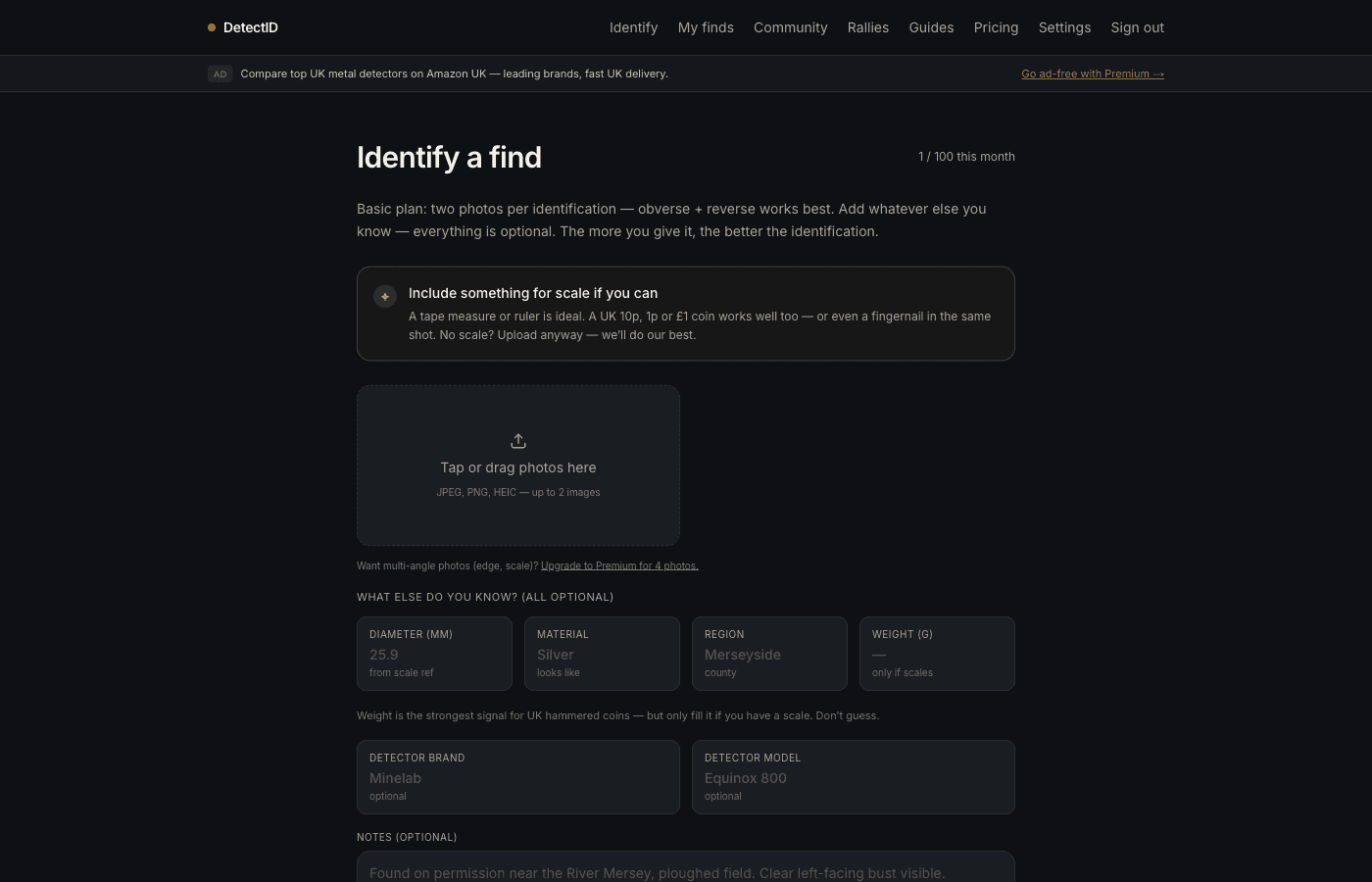
Standard /identify flow works fine for beach finds. Two practical notes:
- Region.Set the Region field to the beach location (e.g. “Norfolk coast”, “Cornish beach”). The engine adjusts for the kinds of finds historically associated with that coastline.
- Notes.Write the substrate you found it in (“wet sand at low tide”, “dry sand near the dunes”, “wrack line”). The engine uses context where it can.
Modern jewellery and DetectID
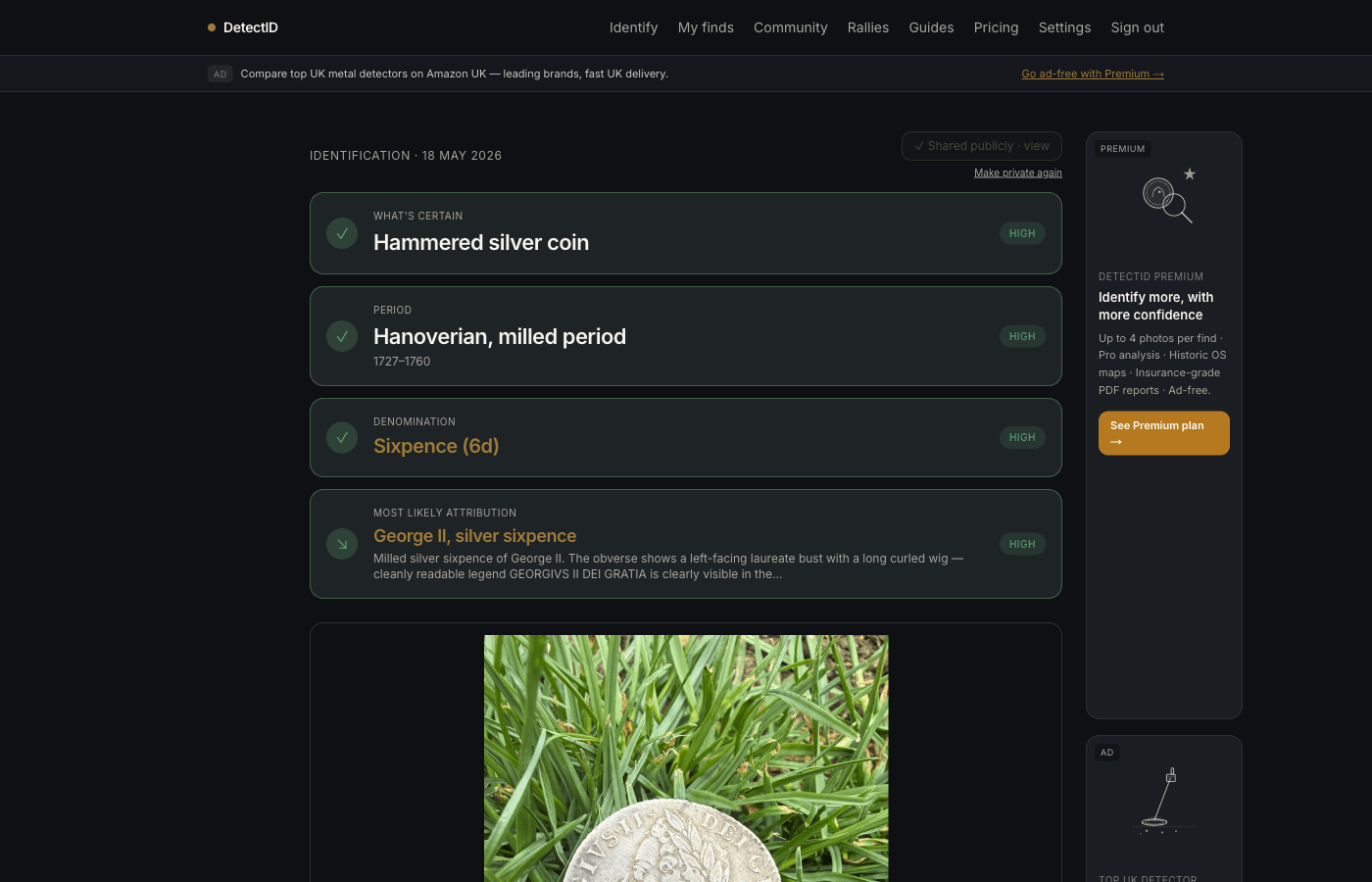
DetectID identifies coins, tokens, and many artefact categories well. Modern jewellery is harder — rings without hallmarks, chains without trademarks, generic pendants. The engine will return what it can read but isn’t calibrated as a jewellery valuer.
For hallmarked gold or silver jewellery, the engine reads hallmarks where they’re visible and gives you the assay office, date letter, and standard mark. Useful for separating 9ct from 18ct, dating a piece, and deciding what to do next with it.
Beach detecting and the law
UK beach detecting access is mixed:
- Below the mean high water mark— Crown Estate owns most of the foreshore. The Crown Estate’s policy permits hobby detecting on most beaches.
- Above mean high water mark— private land or local council. Permission required.
- Protected sites— some beaches are Scheduled Ancient Monuments or have heritage protection. No detecting without specific consent.
- Bye-laws— some local councils have specific restrictions. Check your council’s detecting policy.
Recording beach finds with PAS
Pre-1700 finds from a beach should still be reported to your FLO. Modern jewellery doesn’t need recording. The responsible-finder hand-in expectation (lost property law) for recent jewellery is to report it to the local police non-emergency line — technically valuable lost property belongs to the loser, and if unclaimed after 28 days reverts to the finder.
Common beach detecting questions
What about magnet fishing on the same trip?
Magnet fishing finds (iron objects from waterways) are not what DetectID is built for — they’re mostly heavily corroded iron without diagnostic features. DetectID will return “heavily corroded iron object” for most. The platform is calibrated for non-ferrous detector finds.
Are wreck-coins Treasure?
Maybe. UK shipwreck law has its own framework (the Merchant Shipping Act and Receiver of Wreck obligations). Find something identifiable as wreck-derived — clusters of similar coins, ship’s fittings — and report to the Receiver of Wreck via gov.uk.
Does beach corrosion affect grading?
Yes — the engine grades on visible surface. Heavily salt-pitted coins grade lower than the same coin from a clean field environment. The grade reflects reality; it’s not an over-conservatism.
Worked example — a Victorian silver shilling from a wrack line
You find a heavily blackened silver coin in the wrack line at low tide. Quick rinse in fresh water, soak overnight, gentle brush. The coin photographs as a Victorian shilling with a partially-legible date.
DetectID reads:
- Material silver, diameter 23 mm, weight 5.6 g — UK shilling fabric.
- Bust style: Old Head Victoria (1893–1901).
- Reverse: shield in collar — standard shilling reverse for the period.
- Date partially legible: “189&_” with the final digit obscured by corrosion.
- Class: Victorian Old Head shilling, 1893–1901. Grade: Good (G).
Next steps
- Cleaning salt-corroded finds: Cleaning hammered silver + Cleaning Roman bronze (chemistry is similar to salt corrosion).
- Photographing for DetectID: Photographing finds for identification.
- Reading the grade on corroded finds: Reading the predicted grade.
Try DetectID on a real find
Upload a photo and we’ll return a calibrated shortlist with period, denomination, ruler and full reasoning chain.
Identify a find