Reading the predicted grade on your DetectID result
What each grade (P through UNC) means for a UK detecting find, how the engine arrives at the grade, and how value changes across the grade scale.
DetectID assigns a grade to every coin identification — from Poor (P) through Uncirculated (UNC) on the standard UK numismatic scale. Here’s what each grade means in detectorist terms, what it tells you about value, and the limits of automated grading.
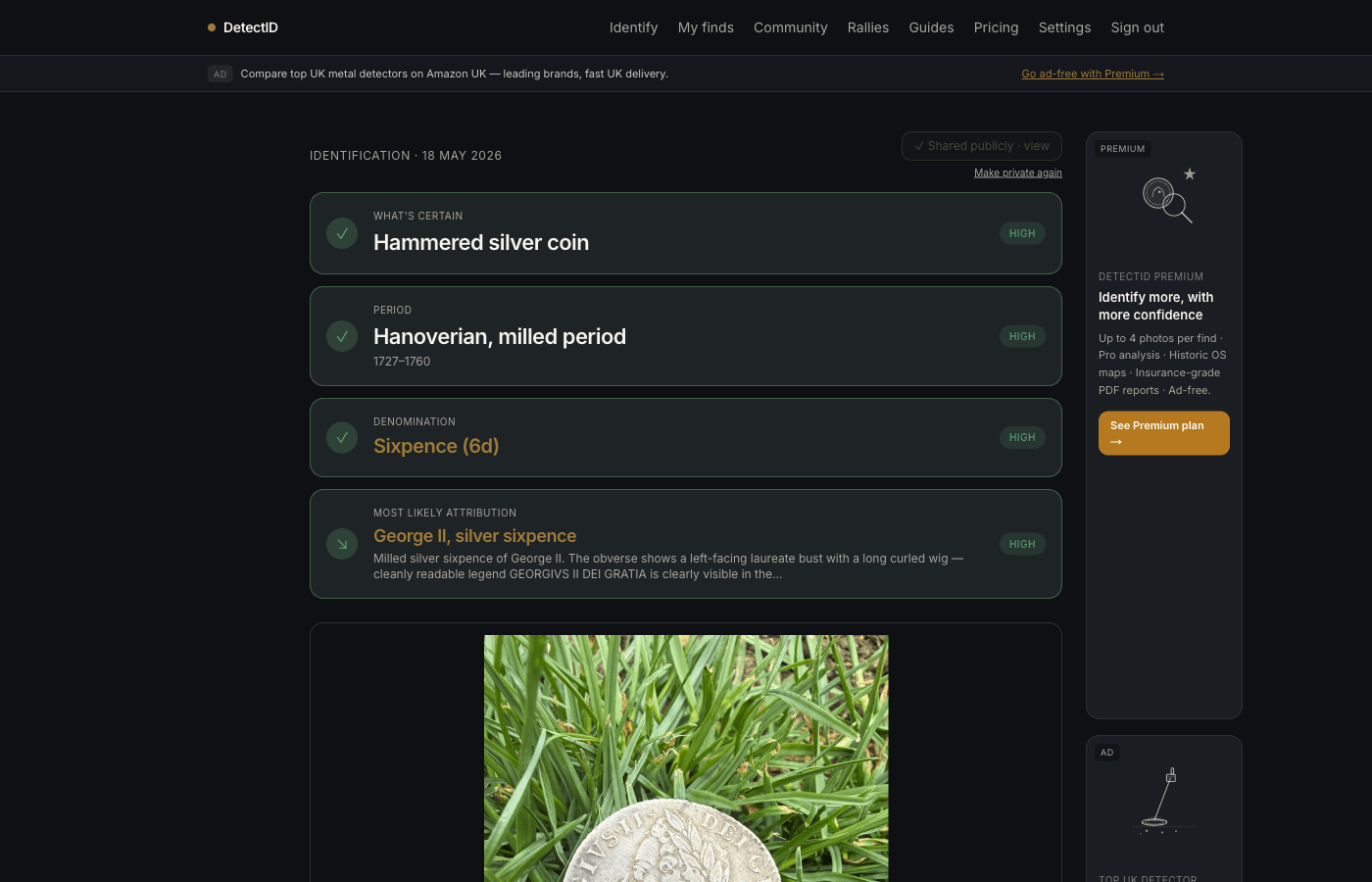
The full scale, with detectorist context
Standard order from worst to best:
P — Poor
Outline only. The coin is recognisable as a coin and possibly as a type, but legend and detail are essentially gone. Common for finds from heavily-ploughed soil that have spent centuries rolling around.
A Poor hammered silver penny is still a real archaeological record — record it with PAS and keep it — but it carries minimal collector value.
Fr — Fair
Major features visible (bust outline, cross outline) but no detail. Type sometimes identifiable; ruler usually not.
AG — About Good
Enough detail returning that the coin can be cautiously dated. Some legend may be partially readable. Bust outline is clear but with no detail. Common detectorist grade.
G — Good
Legend partially readable, often a few letters at a time. Bust has some visible internal detail (eye position, hair direction). Identifiable to ruler if any legend survives. A solid detectorist find.
VG — Very Good
Most of the legend readable. Bust detail visible (facial features, hair, crown). Reverse design clear. Ruler attribution confident. Above-average detector find — a coin you’d be pleased to show at a club night.
F — Fine
Standard detector find at its best. All major detail readable, legend readable around most of the circumference, some surface wear smoothing the highest points. This is what most well-preserved detector finds look like.
VF — Very Fine
Better than typical detector finds. Sharp detail throughout; only the highest points show wear. Legend completely readable. Mint mark or initial mark identifiable. A genuinely nice coin.
EF — Extra Fine
Sharp detail throughout including high points. Minor surface wear on a few specific places (the highest curl of a bust, for instance). Rare from detector finds — usually only seen on coins from drier deposits or recently-lost issues.
AU — About Uncirculated
Almost no wear. The kind of coin that’s been buried very soon after striking and protected by stable soil. Quite rare on UK detector finds — more common on Continental Roman bronze.
UNC — Uncirculated
Full original detail, no wear at all. Effectively as struck. Very rare on UK detector finds; mostly seen on more recent issues (Victorian and later).
What grade tells you about value
Rough multipliers for the same coin at different grades (very approximate — varies by issue and rarity):
- P → Fr: 1.5–2×
- Fr → G: 2–3×
- G → F: 3–5×
- F → VF: 2–3×
- VF → EF: 2–4×
- EF → UNC: 2–10×
For most detectorist finds you’ll see grades clustered between G and F. A jump from F to VF can double the market value.
How DetectID arrives at a grade
The engine looks at:
- The highest-point wear. On a portrait coin, the highest hair curl, the brow, the top of the crown. On a reverse, the central motif. If these still show original detail, the grade is high.
- Legend completeness.Percentage of the surrounding legend that’s readable.
- Surface integrity.Pitting, corrosion, scratches all knock the grade. A coin with sharp detail but heavy pitting can’t reach VF.
- Flan completeness.A partial flan automatically caps the grade — you can’t grade what isn’t there.
- Strike quality.Some hammered coins were weakly struck from new — the engine tries to distinguish weak-strike from wear, but this is hard.
What can throw off the grade
- Dirt obscuring detail. The engine reads dirty coins fine for identification but may under-grade them. A gentle clean (see Cleaning hammered silver safely) can revise the grade upward.
- Strong patina. Roman bronze with rich green patina can mask edge detail in photos. The engine accounts for this but may grade conservatively.
- Photo quality.Out-of-focus photos make the engine assume detail is worn when it’s really just blurry. Re-photograph for an accurate grade.
Re-identification after cleaning
If you carefully clean a coin and want a revised grade, simply upload a new identification with the cleaned photos. The engine will produce a fresh grade against the new visible surface. It counts as a new identification against your quota.
The honest limits of automated grading
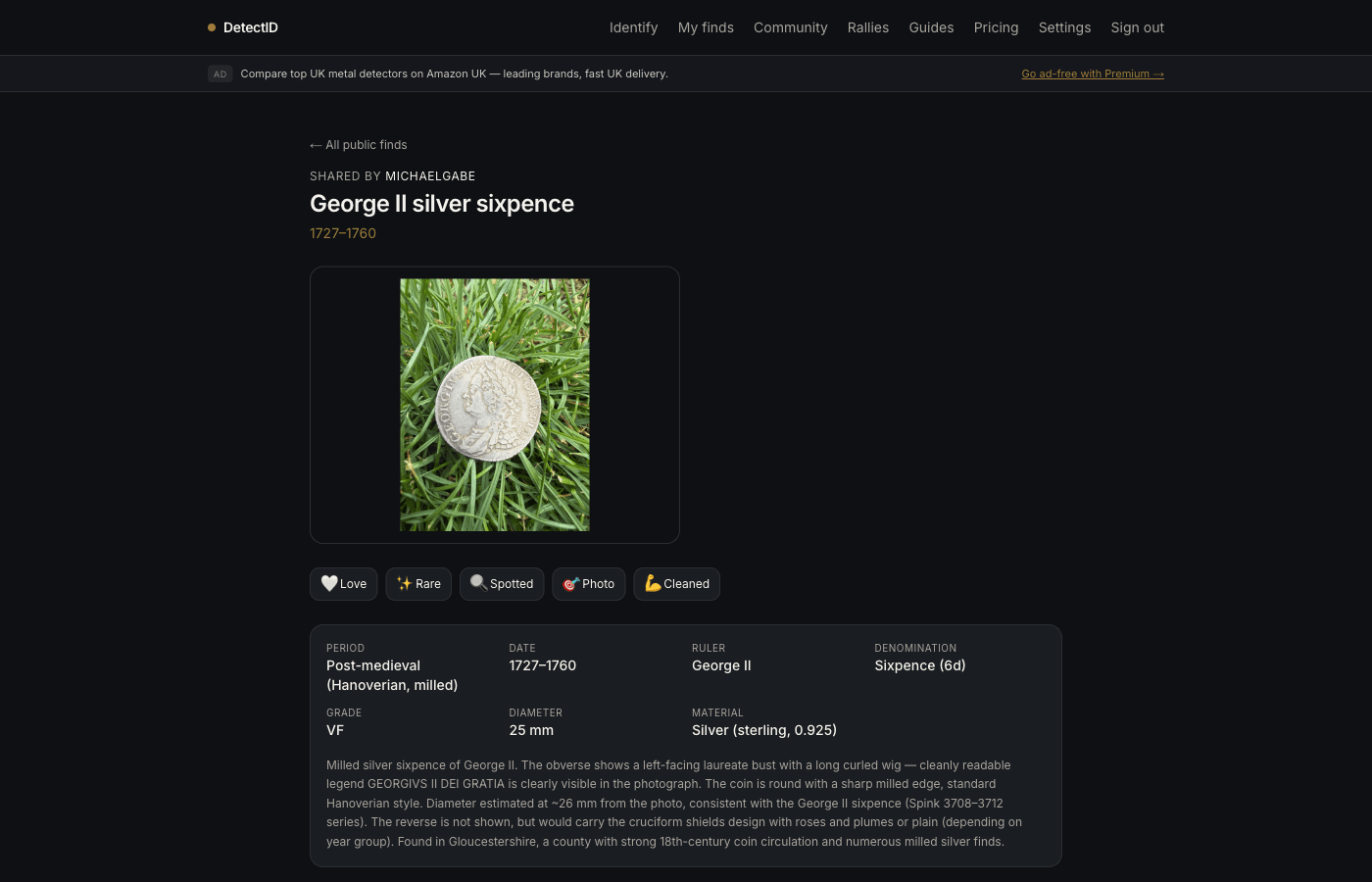
DetectID’s grade is a reasonable approximation, not a certified grade. Professional grading services (CGS in the UK, NGC/PCGS internationally) use multi-step inspection under high magnification, measure die-state, and check for problems DetectID can’t see from a phone photo. For high-value finds going to auction, send to a grading service.
For detectorist purposes — recording finds, tracking progress, comparing to similar coins — the DetectID grade is more than good enough.
Comparing grades across coins
The same grade means different things across coin types. A Fine-grade Henry III long-cross penny looks rougher than a Fine-grade Charles II shilling, because the silver chemistry, striking quality, and burial environment all differ. DetectID grades within the standards expected for the issue — a Fine for a long cross is calibrated against typical long-cross survival, not against Charles II.
Common questions
Can a grade go down?
Yes — if you over-clean and damage the surface, a re-identified coin will grade lower. Over-cleaning is a one-way operation.
Why does DetectID never grade higher than EF for most finds?
Most UK detector finds genuinely don’t reach EF or above. That’s a real reflection of the population, not engine conservatism. The exceptions (early-modern silver from drier deposits, milled coins lost soon after striking) do get higher grades.
Is the grade absolute or relative?
Absolute — standard P-through-UNC scale that matches Spinks, CGS, and most UK numismatic references. A DetectID Fine is calibrated against the same threshold a UK auction catalogue would apply.
Next steps
- If your grade looks lower than expected: Cleaning hammered silver safely.
- How the engine reasons through identification: The reasoning chain demystified.
- Reading the full result page: Understanding your identification result.
Try DetectID on a real find
Upload a photo and we’ll return a calibrated shortlist with period, denomination, ruler and full reasoning chain.
Identify a find