The reasoning chain demystified
How DetectID's reasoning chain works — the diagnostic steps the engine walks through to arrive at every identification, and how to use it when you disagree.
Every DetectID identification ships with a reasoning chain — a numbered list of diagnostic steps the engine walked through to arrive at the verdict. It’s the bit that makes DetectID different from a black-box image search. Here’s how to read it, what each step does, and how to use it when you disagree with the call.
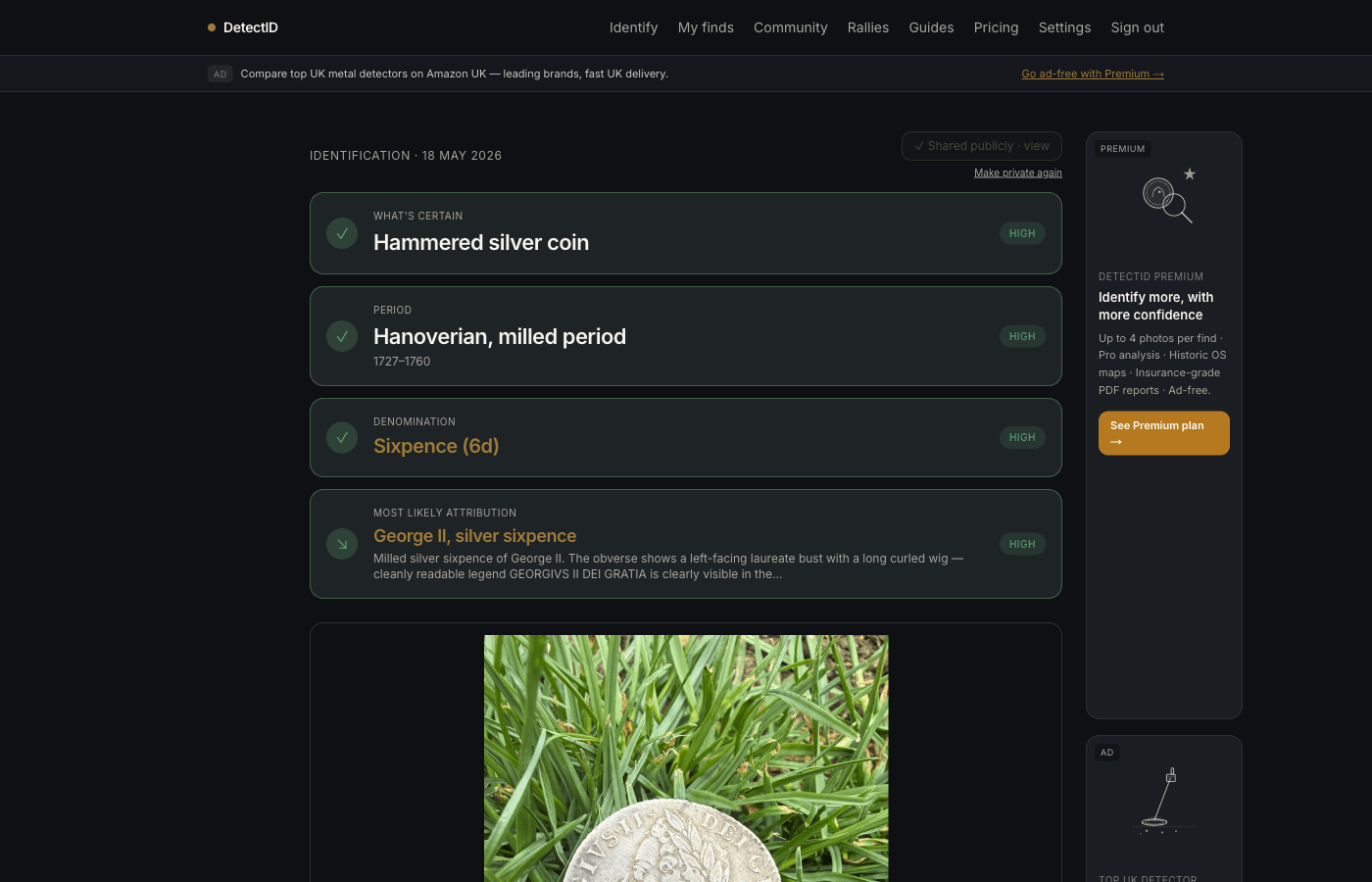
Why a chain rather than just an answer?
Three reasons:
- You can check the logic.A single answer is opaque — if you disagree, you can’t tell why. A chain lets you see exactly which feature the engine read and how it weighted it.
- You learn the methodology. Each chain is a mini-walkthrough of how a knowledgeable numismatist would approach the same coin. Read enough of them and you internalise the diagnostic order.
- It’s honest about uncertainty.A step that says “ruler attribution: indeterminate by legend alone” tells you the engine knows the limits of what it can see.
The standard chain structure
Most identifications follow a five-or-six step pattern. The exact steps vary by period and find type, but the typical structure:
Step 1 — Broad-category triage
What is this thing? Material, rough module, fabric. Places the find in the coarsest bucket: “medieval English silver penny”, “late Roman AE3/AE4”, “Iron Age gold stater”.
Inputs the engine reads: visible material colour and patina, diameter (yours or estimated from scale), weight (yours, if supplied), general fabric (thin and irregular = hammered, thick and regular = milled, very thin and small = pulled out copper flake or Anglo-Saxon sceat).
Step 2 — Portrait or motif fingerprint
What does the iconography say? On portrait coins: bust style, crown type, beard, hair, facing direction. On non-portrait coins: reverse design, central motif, surrounding symbols.
This is where the engine pins the find to a specific reign or coinage period within the broad category. A facing crowned bust on hammered silver narrows to the third coinage of Henry VIII, or the posthumous Edward VI strikings, or one of a handful of Stuart and Commonwealth issues.
Step 3 — Period boundary
Ruling out the reigns on either side of the candidate. This is where weight and module measurements pay off.
Example: a hammered silver penny weighing 1.45 g, 18 mm diameter, with a long-cross reverse. Long-cross pennies are minted by Henry III (from 1247), Edward I, Edward II, Edward III, and into the Wars of the Roses. The weight 1.45 g rules out anything earlier than Edward I’s 1279 reform (Henry III long-cross were lighter). The diameter 18 mm rules out Edward III pennies (slightly larger). The candidate narrows.
Step 4 — Ruler attribution
Which specific monarch. For most coins this is the headline conclusion. For immobilised-legend coinages (Short Cross 1180–1247 used HENRICVS REX even under John and Henry III; Tealby coinage used the same dies for years) the engine will explicitly say the ruler is indeterminate by legend alone — that’s a feature of the coinage, not the engine giving up.
Step 5 — Class or sub-type
Where possible: mint signature, initial mark, lettering style, class number. For Edward I long-cross pennies, this is class 1c vs class 4a vs class 9b etc — each tied to a specific diagnostic feature (initial mark, lettering style, hair treatment).
For very worn coins this step often says “class indeterminate due to wear” — honest about the limit.
Step 6 (sometimes) — Grade and Treasure Act check
The grade comes from a separate visual-wear analysis (seeReading the predicted grade). The Treasure Act flag is raised if the find pattern meets the criteria of the 1996 Act (seeThe Treasure Act flag walkthrough).
How to use the chain when you disagree
The chain makes disagreement productive. When you think the engine has the wrong answer:
- Read the chain from step 1 down. Find the first step where you think the engine reads the find differently to how you would.
- If step 1 is wrong(e.g. engine called it bronze but you think it’s silver), the rest of the chain is built on a wrong foundation. Re-upload with a Material hint and better lighting.
- If step 2 or 3 is wrong (engine missed a diagnostic feature), check whether that feature is visible in your photo. Sometimes a slightly different angle or a closer crop makes the feature visible to the engine.
- If step 4 is “indeterminate”— that’s often the truth for immobilised-legend coinages. Don’t fight it; record the find with the engine’s honest answer.
- If step 5 is missing a class, the photo may not show the diagnostic feature for that class. A closer photo of the relevant feature (the mint mark area, for example) on a Premium plan may resolve it.
Worked example — an Edward I long-cross penny
Imagine you upload a hammered silver penny, 1.4 g, 18.5 mm, with a crowned facing bust and a long-cross reverse. The engine returns:
- Broad-category triage.Hammered silver coin, dark patina, module c. 18 mm, weight 1.4 g — sits squarely in the medieval English silver penny envelope.
- Portrait fingerprint. Crowned facing bust with two pronounced hair-curls either side of the neck. Beardless. Flat-topped crown with three small fleurs. This pins to the Edwardian long-cross series (Edward I onwards).
- Period boundary.Long-cross fourchée reverse + facing bust + 18.5 mm × 1.4 g excludes earlier (Henry III voided long cross used same reverse but different bust style and lower weight).
- Ruler attribution.Edward I (1279–1307) most likely on bust style. Edward II (1307–1327) is an alternative but the fabric quality favours Edward I.
- Class assignment.Class indeterminate due to legend wear — the initial mark and mint signature aren’t legible. Suggest ‘Edward I penny, class indeterminate’.
That’s a complete chain. Every step is auditable. If you disagree with step 4 (maybe you think it’s Edward II based on subtle hair styling), you can pose that to a more experienced detectorist or to your FLO — the chain gives them something to anchor against.
The methodology behind the engine
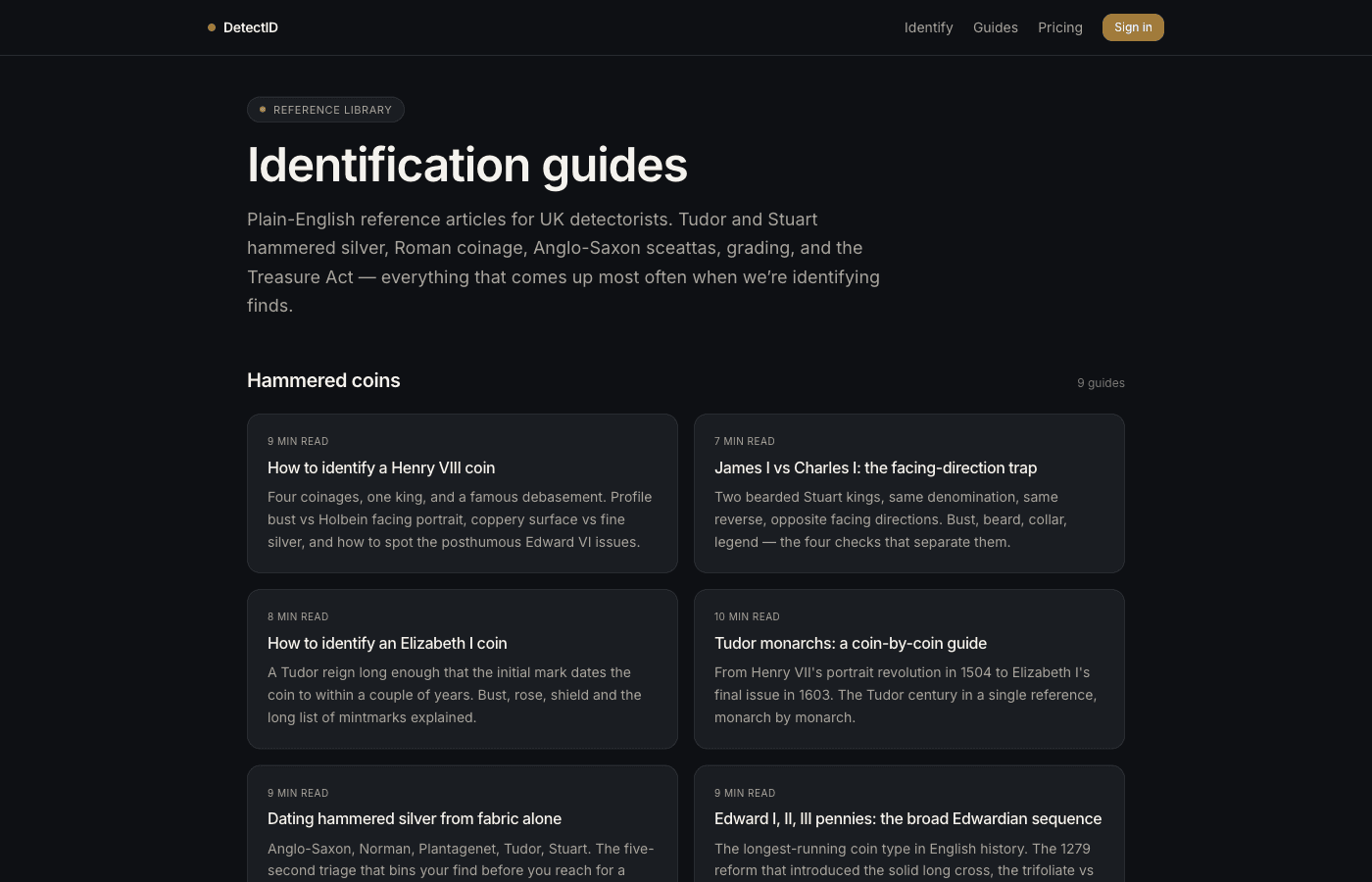
DetectID’s methodology document runs to several thousand lines. It covers diagnostic logic for hammered Anglo-Saxon sceattas, Viking-age pennies, Norman through Plantagenet hammered, Wars of the Roses issues, Tudor coinages (including the great debasement), Stuart milled and hammered, Commonwealth and Cromwell oddities, Restoration milled silver, Georgian and Victorian coinage, Roman coinage by Reece Period, Iron Age tribal staters, and a long tail of non-coin artefacts.
The methodology is what makes the chain consistent across identifications. The engine reads the same diagnostic features for the same coin types every time, and explains its reading in plain English.
Common questions
Do all identifications have chains?
Yes — every identification has a reasoning chain. The length varies; coin identifications tend to be 5–6 steps, artefact identifications can run longer because of more shape and material variants.
What if the chain is wrong but the verdict is right?
Rare but happens. The engine occasionally builds a chain that reaches the right answer via a step that looks off. Flag it from the result page and we’ll feed it back into the methodology improvements.
Can I share a chain with my FLO?
Yes — share the result page URL. FLOs find the chain useful because it speaks their diagnostic language; it can shave time off the recording process.
Next steps
- Reading the result page properly: Understanding your identification result.
- Worn coin handling: How DetectID handles worn and partial coins.
- Reference library of the methodology: DetectID guides.
Try DetectID on a real find
Upload a photo and we’ll return a calibrated shortlist with period, denomination, ruler and full reasoning chain.
Identify a find