How DetectID handles worn and partial coins
Identifying worn, partial-flan, encrusted, bent, and fragmented detector finds — the techniques the engine uses, plus practical advice for getting the best result.
UK detectorists pull a lot of finds out of plough soil. Centuries of being rolled, fractured, scrubbed by sand, and bent by machinery means most of what comes up isn’t in pristine condition. DetectID is built specifically for these — worn, partial, fragmented, half-flan, bent — finds. Here’s how the engine handles each, and how to give it the best chance.
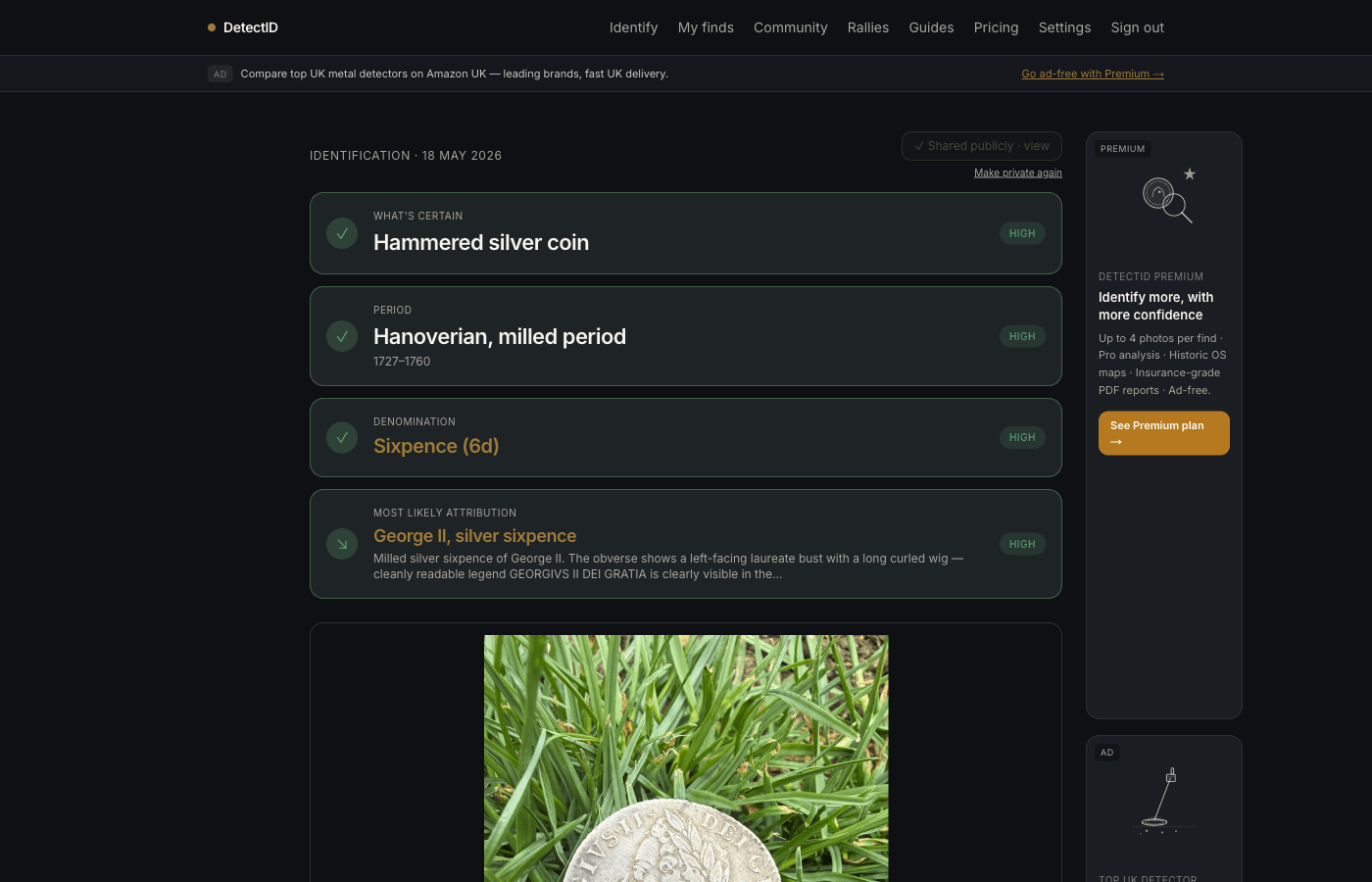
The kinds of worn finds the engine sees
- Surface-worn. Detail smooth on the highest points but the find is structurally intact. Most common.
- Partial flan. Half or more of the coin is missing — broken off in the ground or through striking damage.
- Plough-damaged. Bent, creased, gouged. Modern machinery is harder on coins than centuries of natural soil ever was.
- Heavily encrusted. Mineral deposits obscuring the surface (see cleaning bronze).
- Fragmented. Two or three pieces of what was once one coin. Sometimes recoverable from photos of all pieces side by side.
- Worn-and-bent. Love tokens (S-curved silver, often hammered for sentimental purposes), bent prayer-coins, deliberately mutilated finds.
Surface-worn finds — the standard case
Most worn finds aren’t mysteries to the engine. The methodology accounts for typical wear patterns on each coin type. A Henry III long-cross penny worn down to a smooth obverse will still be identifiable via reverse design, weight envelope, and what fragments of legend survive.
Get the most from a worn find by:
- Cleaning gently (see cleaning silver).
- Photographing in raked light — light from a low angle picks up faint lettering that disappears under overhead light.
- Recording the weight, even if just to one decimal place.
- Noting in the upload form what you can read (even partial letters).
Partial-flan finds
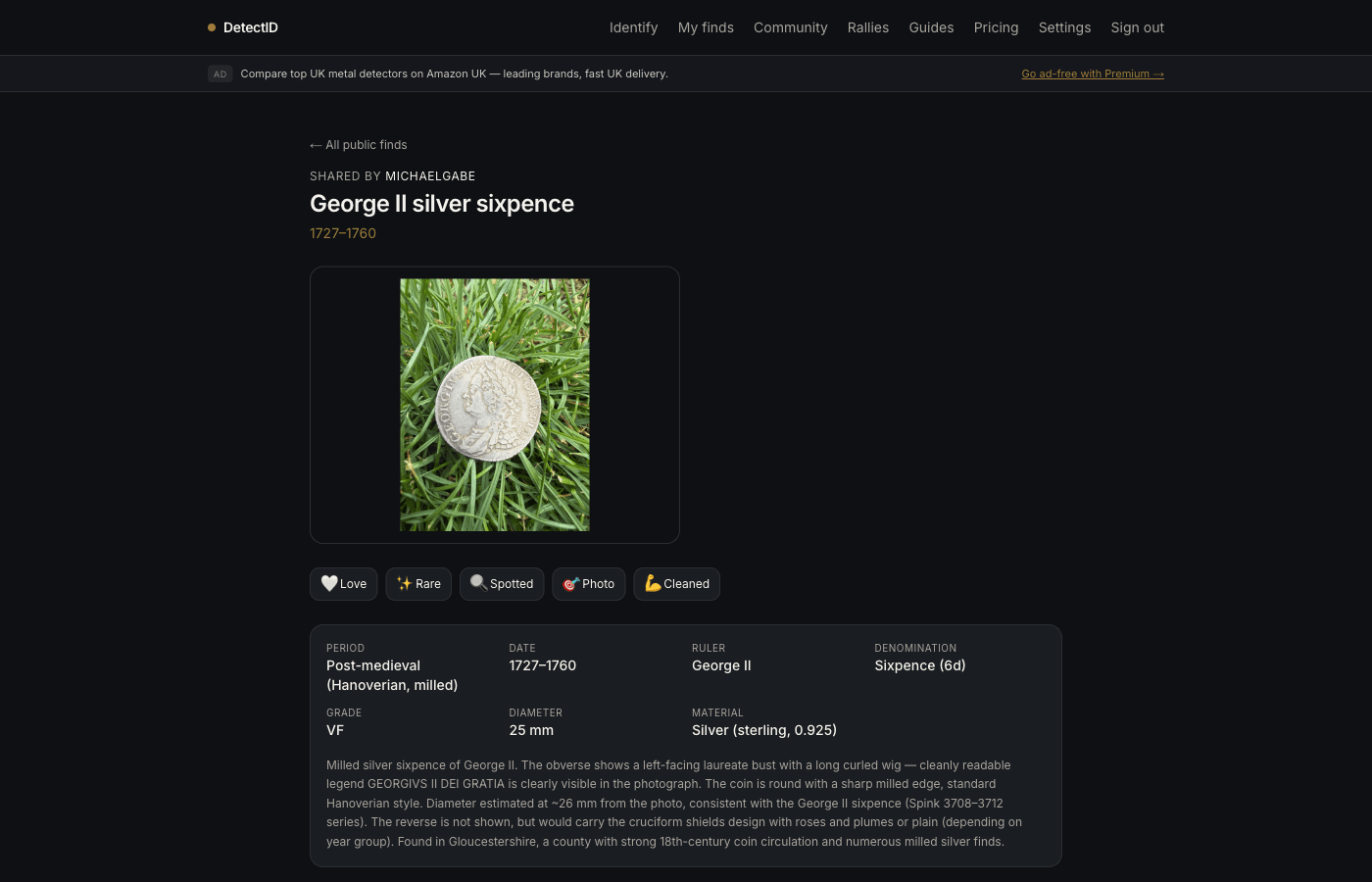
Coins missing 30%, 50%, sometimes 70% of their flan. The engine handles these via three measurement techniques:
Centre-and-rim
If you can identify the centre of the original coin (often obvious from a portrait or reverse motif) and any point on the original rim is preserved, the engine can geometrically calculate the original diameter.
Three-point arc
If three points on the original rim survive (even if 90% of the rim is gone), three points define a circle. The engine fits the circle to those points and reads the diameter from there.
Chord-and-sagitta
On a flatter partial-flan, the chord (straight-line distance between rim points) and the sagitta (height from chord to rim-arc-peak) define the original radius. Useful when no centre is preserved.
Result: a 40% partial-flan hammered silver can still get an accurate diameter estimate and therefore confident period attribution.
Bent coins and love tokens
Bent silver coins are sometimes assumed to be damaged. Often they’re intentionally bent — English love tokens from the 17th to 19th centuries were typically silver sixpences or shillings folded into an S-curve as a romantic gift, with the recipient’s initials sometimes scratched onto the surface.
The engine recognises the S-curve geometry and tags these as love tokens specifically, explaining the cultural context. A bent silver coin is not damage to discount — it’s an artefact with its own collecting niche.
Encrusted finds
Heavy mineral encrustation obscures detail in photographs. The engine can sometimes infer through the encrustation (using partial visible features) but accuracy drops.
Three options:
- Upload now and accept lower confidence on the verdict.
- Clean carefully (long olive-oil soak for bronze; soak-and-brush for silver) over weeks, then re-identify.
- Send to a conservator for high-value finds.
Fragmented finds
Two or three pieces of one coin? Upload all pieces in one identification (Basic gives you 2 photos; Premium gives you 4). Position them so the join is obvious in at least one shot. The engine reassembles the diagnostic features mentally.
Important: weigh the pieces together and put the combined weight in the Weight field. The engine’s weight-based diagnostics rely on the original total.
What worn coins still reveal
Diagnostic features that survive on heavily worn coins:
- Weight. Resistant to wear; reveals the issue period reliably for hammered silver.
- Module (diameter). Wear reduces it slightly but not enough to confuse the engine.
- Patina. Tells the engine the coin is authentic and centuries old.
- Fabric. Thin and irregular = hammered. Thick and even = milled. Survives even when surface detail is gone.
- Reverse motif outline. Cross designs survive far longer than busts because they’re struck deeper into the flan.
- Edge profile. Beaded edge, milled edge, plain edge — a clear edge photo (Premium) can resolve ambiguity.
What the engine won’t do
- Guess wildly on no information.If the find is too worn for any meaningful diagnostic, the engine returns “type indeterminate, possibly hammered silver penny of the 13th–15th century” rather than picking a specific monarch arbitrarily.
- Estimate weight from a photo. The engine relies on what you supply. Weight is too variable across image conditions for reliable inference.
- Add features that aren’t visible.If a legend isn’t readable in the photo, the engine won’t pretend it can read it. The reasoning chain will say so honestly.
Worked example — a half-flan hammered silver
Upload: a fragment of silver, weight 0.7 g, what looks like the right-hand side of a hammered coin, with the outline of a bust and part of a long-cross reverse.
Engine reasoning:
- Material silver, fabric hammered, weight 0.7 g + visible diameter ~9 mm suggests a partial flan of an original coin around 18 mm.
- The bust’s visible profile shows a facing crowned bust style.
- Long-cross reverse on the back, with visible cross arms reaching the rim.
- Period match: medieval English silver penny, long-cross series.
- Ruler attribution: most likely Edward I or II based on bust style; legend insufficient for certainty.
Verdict: “Probable Edward I long-cross penny, partial flan”, medium confidence. PAS-recordable as a 13th/14th-century hammered silver penny.
Tips that genuinely improve worn-find identifications
- Always weigh. Even a partial flan’s weight is informative.
- Photograph in raked light. Low-angle daylight reveals legend ghosts invisible under overhead light.
- Don’t over-clean. The patina that’s left is often what’s holding the find together.
- Note your guess. The Notes field on /identify is read by the engine. If you think it’s an Edward I penny, say so — the engine takes that as a hypothesis to confirm or rule out, not as a fact.
- Re-identify after cleaning. A second pass on the same coin after a gentle clean can move the verdict up by a confidence tier.
Next steps
- Photographing for the engine: Photographing finds for identification.
- What the grade means on a worn find: Reading the predicted grade.
- Reading the chain on a worn find: The reasoning chain demystified.
Try DetectID on a real find
Upload a photo and we’ll return a calibrated shortlist with period, denomination, ruler and full reasoning chain.
Identify a find