Hearts, comments, and community etiquette on DetectID
How DetectID's community surface works — hearts and comments on public finds, soft etiquette rules, moderation policy, and what we don't do (no DMs, no follower counts).
DetectID has a small but real community surface: public finds in the discovery feed, hearts you can leave on a find, comments where you can ask questions or share knowledge. It’s deliberately quiet by design. Here’s how it works and the soft rules of the road.
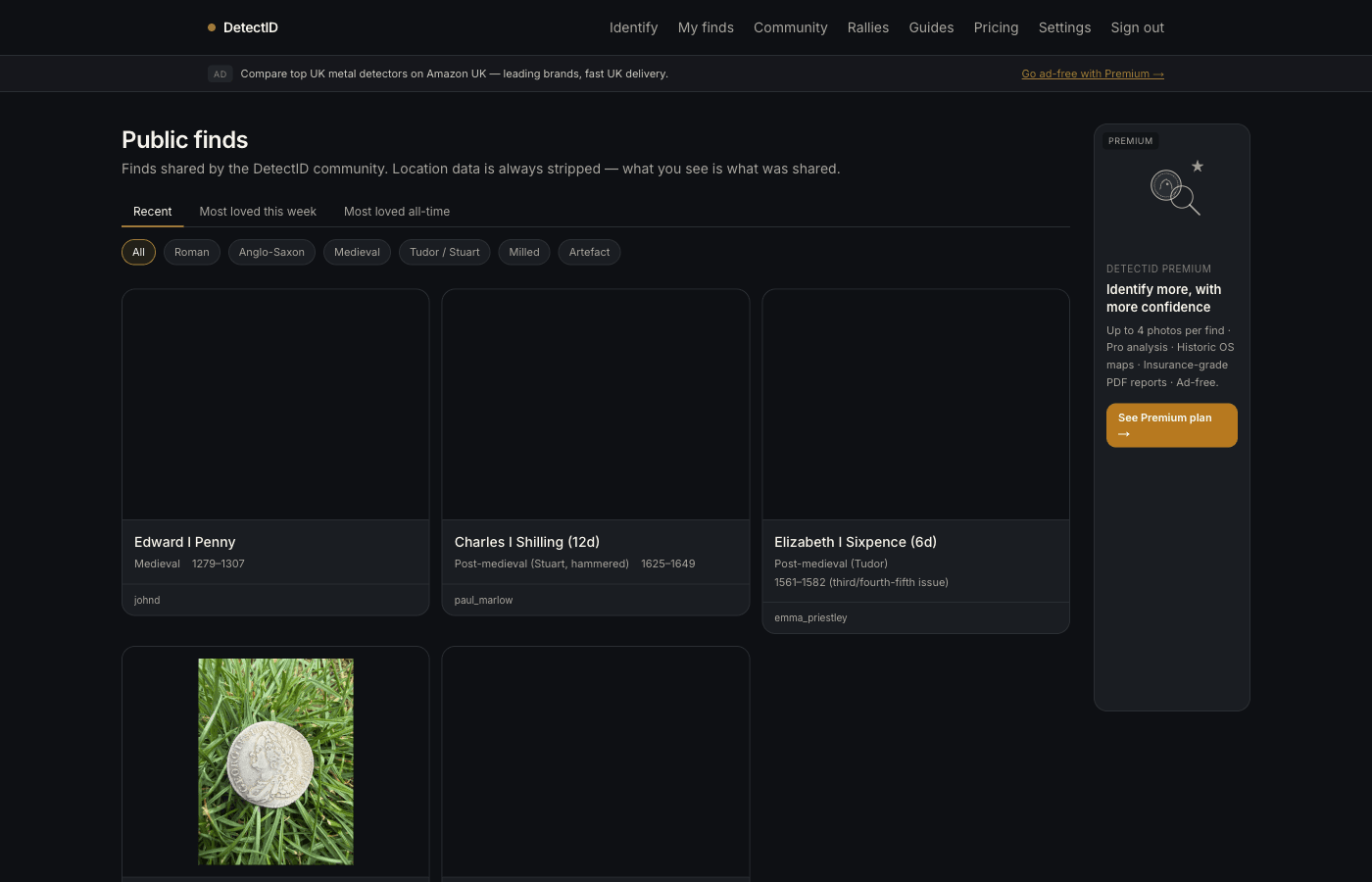
What you can do on a public find
- Heart.One tap. Adds a count to the find’s heart counter, visible to everyone. No inbox-spamming the finder — we don’t send notifications for hearts.
- Comment. Up to 500 characters. Comments appear on the find page chronologically. The finder gets a single daily-summary email of new comments on their finds.
- Click through to the finder’s profile.See what else they’ve shared, what they specialise in.
- Report. A small flag for content that breaches the rules.
Why no follower mechanic?
Two reasons we haven’t added follows:
- Privacy.Follower counts and lists create social-pressure surfaces that can feel intrusive to detectorists who value the hobby’s discretion.
- Quality. A small heart-and-comment surface on individual finds keeps engagement focused on what was actually found, rather than on accumulating followers for their own sake.
We may add follows in a future update if there’s clear demand, but the bar is high — we don’t want a leaderboard culture creeping in via the back door.
The soft etiquette
Comments that work well
- Specific praise. “Lovely full flan on that long-cross — what came off the same field?” beats “Nice find!”.
- Helpful corrections. If you spot something the engine missed — a class indicator, a mint mark — share it. Politely.
- Questions about technique. “What detector were you using? What soil?” is welcome.
- Cleaning advice. If the finder is asking how to clean a particular type, a respectful suggestion is welcome.
Comments that don’t work
- Asking for the find spot. Don’t. Permissions are private; the location precision is set deliberately. Asking publicly puts the finder in an awkward spot.
- Confidently wrong identifications. If you’re going to disagree with the engine, show your working — a flat “that’s actually a [X]” without reasoning isn’t useful and often is itself wrong.
- Inflated valuations. Suggesting a Henry III penny is worth £500 when it’s really worth £15 misleads the finder. Quote auction comparables if you have them.
- Off-topic. A coin find is not the place for politics, jokes about the finder, or unrelated detecting stories.
- Self-promotion. Don’t link to your YouTube channel under every find. Promote your work on your own profile.
Hearts — what they signal
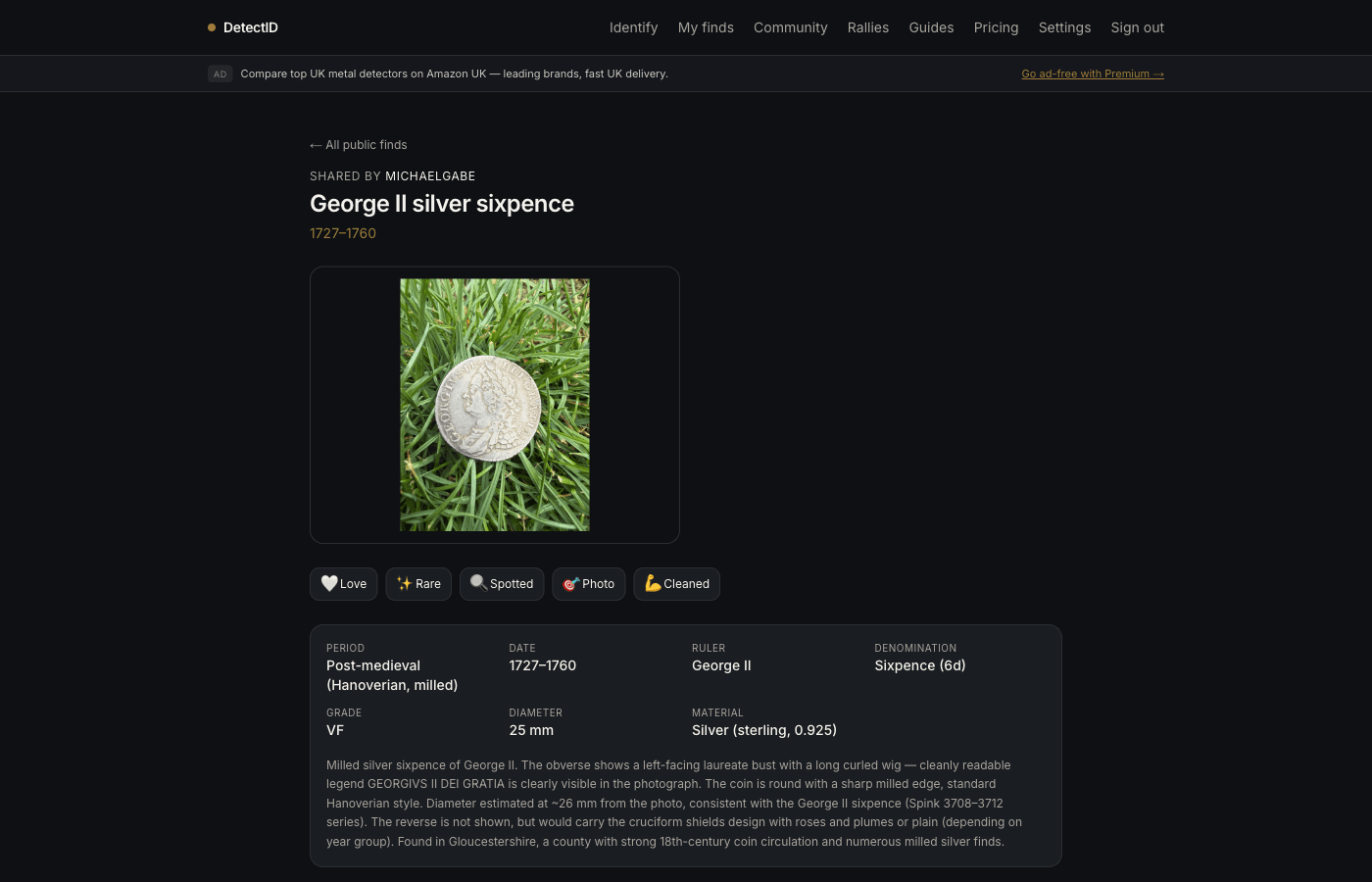
Hearts are a quiet thumbs-up. They’re not a leaderboard; we don’t rank finds by heart count, we don’t use them for Find of the Week selection, and we don’t notify the finder for each one. What hearts do:
- Tell the finder their find resonated.
- Give us a soft signal of what the community finds interesting (used for editorial discovery, not algorithmic boosting).
- Let you mark finds you want to find again later (your own heart-list is visible from your profile).
Moderation — how we handle reports
Every public find and comment has a small report flag. Reports go to a moderation queue reviewed by the admin team. Categories we action:
- Suspected stolen finds.We’ll investigate and cooperate with the police if asked. Stolen property is removed.
- Detecting without permission. Specifically flagged content (e.g. a find clearly from a protected site or admitted no-permission) is removed.
- Abusive comments. Removed; repeat offenders banned.
- Spam / self-promotion. Removed.
- Misleading identifications used to inflate value.Removed if obviously commercial fraud.
Categories we do NOT action:
- Finds you disagree with the identification of.
- Finds where you don’t like the finder.
- Comments you disagree with that aren’t abusive.
- Generic “I think this is wrong” reports without specifics.
If a comment crosses a line
- Don’t reply in kind. Public arguments on find pages help nobody and degrade the space.
- Use the report flag. One tap, takes 5 seconds. Admin gets it.
- Block the user. From your Settingsunder “Blocked detectorists”, you can block specific accounts. A blocked user’s comments stop appearing on your finds.
- If the abuser is targeting you across multiple finds, email us. We can investigate patterns of behaviour and ban repeat offenders.
The DetectID culture we want
The community we’re trying to build is broadly: knowledgeable, respectful, curious, helpful with newcomers, protective of the hobby’s reputation. The opposite of the YouTube-comments register. Most detectorists are already wired this way — the rules above are mostly to set expectations for anyone arriving from elsewhere.
A few practical things this looks like:
- Senior detectorists helping a newcomer identify a worn find without making them feel small.
- Cleaning advice freely shared — with the caveat that less is more.
- A culture of recording finds with PAS, even the modest ones.
- Respect for permission-keeping — nobody asks for fields.
Public profile interactions
On your public profile, other detectorists can see what you’ve shared but can’t message you directly through the site. If they want to get in touch, they need to find you on social media or via your club. We don’t provide an in-platform DM system deliberately — DMs are an attack vector for spam and harassment that’s hard to moderate at small-team scale.
Common questions
Can I see who hearted my finds?
No. Hearts are anonymous — you see the count, not the names. This is deliberate: it keeps the gesture lightweight, and avoids social-pressure dynamics around who is and isn’t hearting whom.
Can I delete my own comments?
Yes — from the comment itself, you can edit or delete within 30 minutes of posting. After that, comments are permanent (but you can request deletion via support if there’s a genuine reason).
Can I block a specific user?
Yes. Go to Settings → Profileand scroll to “Blocked detectorists”. A blocked user’s comments stop appearing on your finds. You can unblock from the same screen.
Does DetectID make money from engagement?
No. Identification subscription is the revenue. Engagement helps the platform grow (more finds shared = more new users seeing what’s possible) but we don’t monetise time-on-site, don’t serve engagement-bait, and don’t want a feed full of rage.
Next steps
- How to share a find in the first place: Sharing finds publicly.
- Your visible presence: Building your public profile.
- What other users can see: Privacy and location precision.
Try DetectID on a real find
Upload a photo and we’ll return a calibrated shortlist with period, denomination, ruler and full reasoning chain.
Identify a find