For Finds Liaison Officers — what DetectID offers and what it doesn't
A page written specifically for FLOs: how DetectID's reasoning chain can save write-up time, what the engine is honest about, the methodological provenance, and the free institutional account offer.
This post is written specifically for Finds Liaison Officers. If you're an FLO who's been forwarded a DetectID identification by a detectorist, or you've heard the platform mentioned and want to know what it actually does and whether it's worth your time, this is the page to read.
What DetectID is, in one paragraph
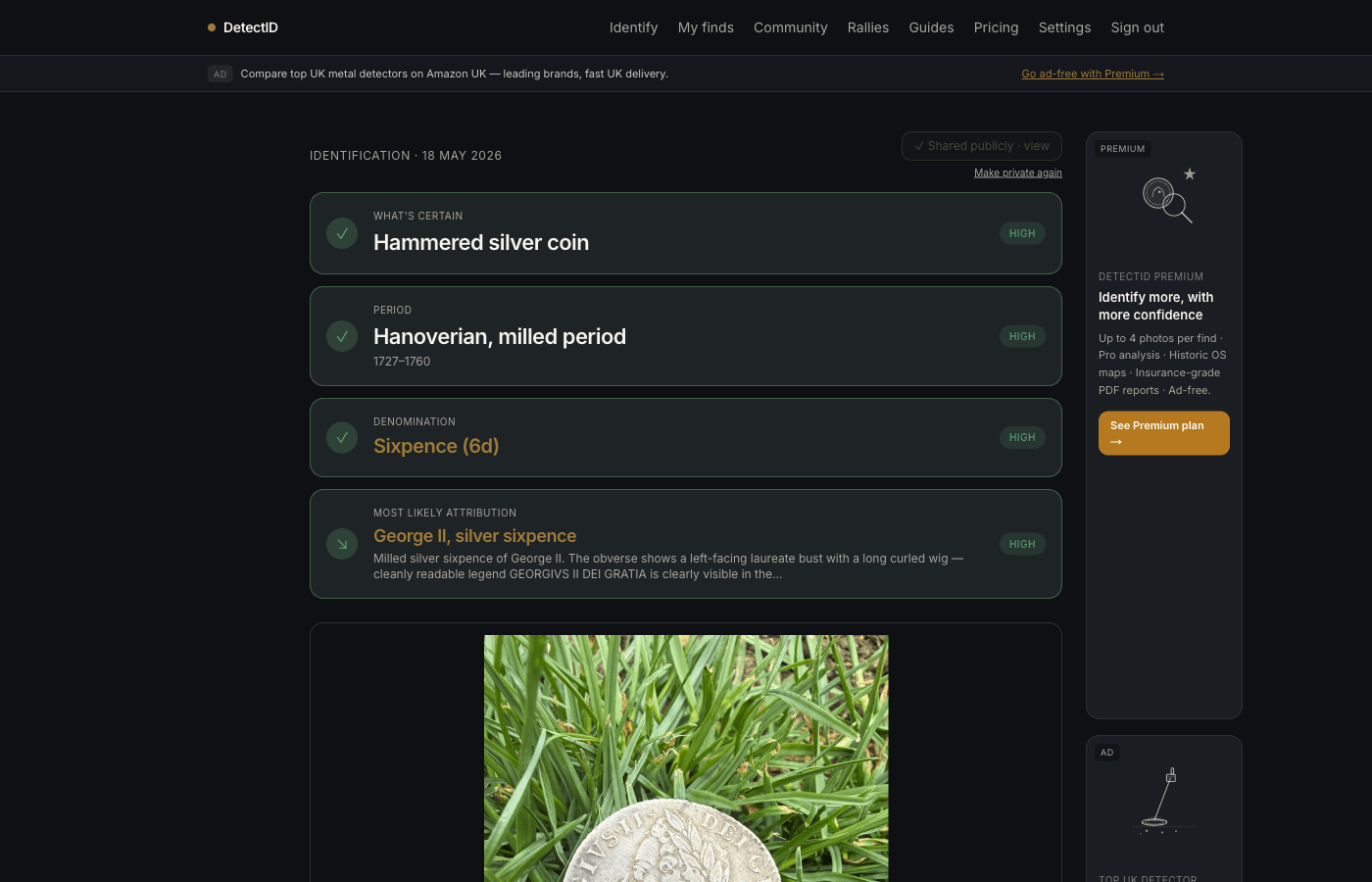
DetectID is an identification platform for UK metal-detecting finds, built around an engine calibrated against the standard diagnostic methodology a numismatist or FLO would apply: broad category triage, portrait or motif fingerprint, period boundary, ruler attribution, class or sub-type. The methodology document underpinning it draws from Spink, North, the British Numismatic Journal, Reece's period system for Roman coinage, the Fitzwilliam Early Medieval Coin Corpus, and the published PAS guides themselves. The output to the user is not a single verdict but a written reasoning chain that exposes each diagnostic step, the evidence the engine read from the photo, and what it concluded.
Why the reasoning chain matters for an FLO
The reasoning chain is what makes DetectID useful to you specifically. When a detectorist brings you a find that they've already run through DetectID, they can forward the result-page URL. What you get is, effectively, a pre-drafted first-pass write-up:
- Top candidate: ruler, denomination, period, date range, predicted grade, in the same vocabulary you'd use.
- Reasoning chain: each step named and explained — “Crowned facing bust with two pronounced hair-curls either side of the neck…”.
- Alternatives: the second and third most plausible candidates, each with its own reasoning.
- Honest limits: where the engine could not commit, it says so explicitly — class indeterminate due to legend wear, ruler indeterminate by legend alone for immobilised-legend coinages, partial flan flagged.
- Treasure Act flag: raised where the criteria of the 1996 Act may apply, with a plain-English explanation of why.
Where the engine is correct, you verify and adapt for your record. Where it's wrong, the chain shows you which diagnostic step it misread — often quicker to refute and replace than to construct an identification from scratch.
In a small early-adopter cohort, FLOs have reported that this cuts a meaningful chunk off the routine end of the recording workload, especially on hammered silver and Roman bronze where the diagnostic logic is mature.
What it does NOT do, deliberately
- Auto-report finds. DetectID never submits anything to the PAS database or to authorities. Recording remains a deliberate act by the detectorist via your normal channels.
- Determine Treasure status. The Treasure Act flag is a suggestion to the user that the criteria may apply. It does not make a legal determination, does not notify a Coroner, and does not bypass the FLO's role in the process.
- Replace FLO judgement. The engine is calibrated to refuse rather than guess when it can't get there. On unusual finds, the alternatives column will surface plausibility but the chain remains explicit about what isn't certain.
- Value finds.No estimated price, no auction comparable, no Treasure Valuation Committee equivalent. Grade is on the standard P–UNC scale, calibrated to what's visible in the photo.
- Identify findspots. Detectorist location data is gathered with explicit privacy precision settings (exact / 1 km grid / 10 km grid / county / hidden) and never shared on public surfaces beyond the precision the detectorist chose. EXIF GPS is stripped at upload.
Where the engine is strongest
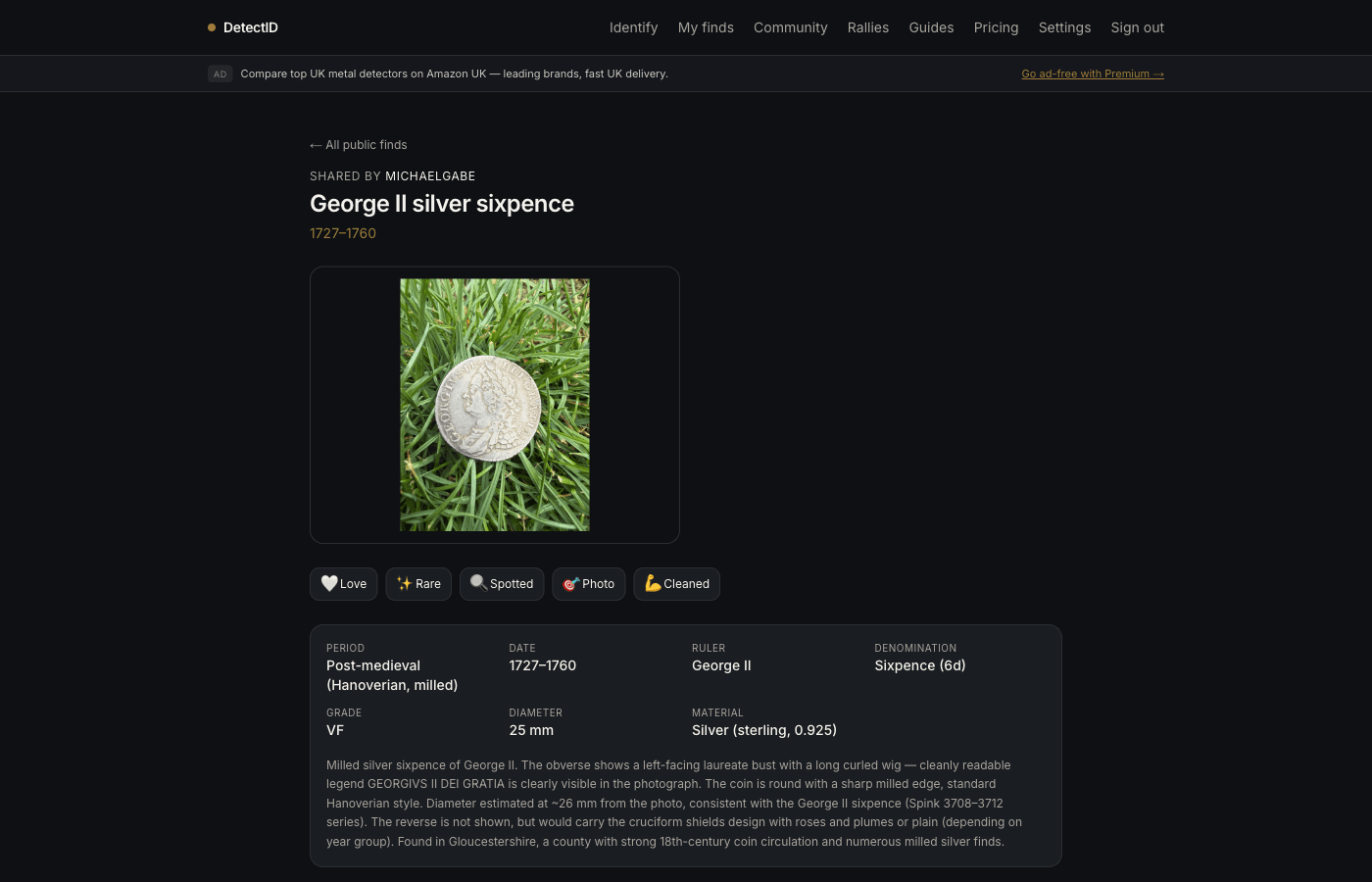
- UK hammered silver pennies, halfpennies, groats, half-groats — particularly the Edwardian long-cross series, Henry III voided long cross, Tudor coinages including the Holbein facing bust transition, Stuart milled and hammered silver.
- Late Roman AE3 and AE4 issues, identified down to Reece period and (where visible) emperor and reverse type.
- Common Roman provincial bronze.
- Anglo-Saxon sceattas at series level (primary / secondary phase).
- Milled silver from Charles II through to Victoria, with date attribution where the legend is legible.
- Brooches, buckles and strap-ends at typological level.
Where the engine is honest about being weaker
- Immobilised-legend coinages (Short Cross HENRICVS REX 1180–1247, Tealby coinage, baronial issues) — the chain explicitly states ruler indeterminacy and explains why.
- Heavily encrusted bronzes where the diagnostic surface is below the patina.
- Worn coins on rare types where the diagnostic features required are not visible.
- Non-coin artefacts outside the typological zoo it's been trained on (very local or single-find object types).
Worked example — an Edward I long-cross penny
A detectorist uploads a hammered silver penny, 1.4 g, 18.5 mm diameter, crowned facing bust, long-cross reverse. The engine returns this reasoning chain:
- Broad-category triage.Hammered silver coin, dark patina, module c.18 mm, weight 1.4 g — sits squarely in the medieval English silver penny envelope.
- Portrait fingerprint. Crowned facing bust with two pronounced hair-curls either side of the neck. Beardless. Flat-topped crown with three small fleurs. This pins to the Edwardian long-cross series (Edward I onwards).
- Period boundary.Long-cross-fourchée reverse + facing bust + 18.5 mm × 1.4 g excludes earlier (Henry III voided long cross used same reverse but slightly different bust style and lower weight).
- Ruler attribution.Edward I (1279–1307) most likely on bust style. Edward II (1307–1327) is an alternative but the fabric quality favours Edward I marginally.
- Class assignment.Class indeterminate due to legend wear. The diagnostic features (initial mark, mint signature, lettering style) are not legible. Suggest ‘Edward I penny, class indeterminate’.
The detectorist forwards this URL to you. Your verification is: confirm the diagnostic features the engine read are what you see, accept or refute the ruler attribution, and adapt for your PAS record. The class-indeterminate flag tells you the engine has hit the same limit you would; the alternatives column gives you the Edward II option to weigh.
What we'd like to offer
A free institutional account at the Premium tier — 200 identifications per month, all features. No card details, no trial expiry. Sign in at app.detectid.co.uk/auth/login and reply to my outreach email with the address you used. I'll credit Premium immediately.
Use it however is most useful to you: run public submissions through it before you write up, accept DetectID URLs from detectorists who already use it, or just have it as a reference for second opinions on awkward finds.
Methodological provenance
The methodology document the engine works from is a single long reference text covering each period and find type, with explicit citations into the standard literature. Where the diagnostic logic differs between authorities (e.g. on the boundary between Edward I and Edward II long-cross pennies), the methodology document captures both views and the engine surfaces the disagreement in the alternatives column rather than committing arbitrarily.
The reference base includes: Spink’s Coins of England editions, North's English Hammered Coinage, the British Numismatic Journal back catalogue (with specific reference to the 1998 vol.68 paper on Tealby and the classic papers by Lawrence, Fox & Fox, Allen and Potter on the Edwardian long-cross series), Reece's Coinage in Roman Britain period system, the Fitzwilliam Early Medieval Coin Corpus, Cotswold Archaeology's typological work on medieval finds, the published Portable Antiquities Scheme FLO guides for individual object categories, and Hall's Hammered Coins of England reference on Short Cross and related immobilised-legend coinages.
Privacy and the integrity question
Findspot data
Detectorist findspot data is gathered with explicit privacy precision (the user chooses exact, 1 km grid, 10 km grid, county-only, or hidden). EXIF GPS is stripped at upload. Public surfaces only ever show the precision the user chose, and exact precision is never shared publicly even on opted-in finds. We don't aggregate findspot data and we don't share it externally. Full detail in our Privacy and location precision post.
Engine integrity
The engine is deliberately calibrated to refuse rather than guess. On finds where the diagnostic features required for confident attribution are not visible, the result returns at Medium confidence with an explicit list of what would resolve it (a clearer reverse photo, a weight measurement, an edge shot). It does not pick a ruler at random to fill the slot. The methodology document is internally consistent in this regard; the reasoning chain exposes the limit.
How to get in touch
Email admin@detectid.co.uk and we'll set up your free Premium institutional account, or respond to whichever outreach email you received. Happy to come and demo in person if you're within a reasonable distance and would find that useful.
If after trying it you have feedback — the engine misread something, the methodology has a gap on a specific type, the result page is missing a feature you'd want as an FLO — we genuinely want to hear it. The product improves fastest when FLO feedback comes in.
Related reading on the platform
- The reasoning chain demystified — how the engine arrives at every verdict, step by step.
- The Treasure Act flag — what it means and what to do.
- Reporting finds to PAS — the user-facing version of recording with FLOs.
- How DetectID handles worn and partial coins — the geometric partial-flan methodology and immobilised-legend handling.
- DetectID guides — the in-depth reference library.
Try DetectID on a real find
Upload a photo and we’ll return a calibrated shortlist with period, denomination, ruler and full reasoning chain.
Identify a find