Frequently asked questions about DetectID
The most common questions about DetectID answered honestly — the engine, plans, privacy, PAS reporting, rallies, devices, and a few sceptic's questions.
A comprehensive FAQ — the most common questions we get about DetectID, answered honestly. If your question isn’t here, email us or check the more specific walkthroughs on the blog.
The basics
What is DetectID?
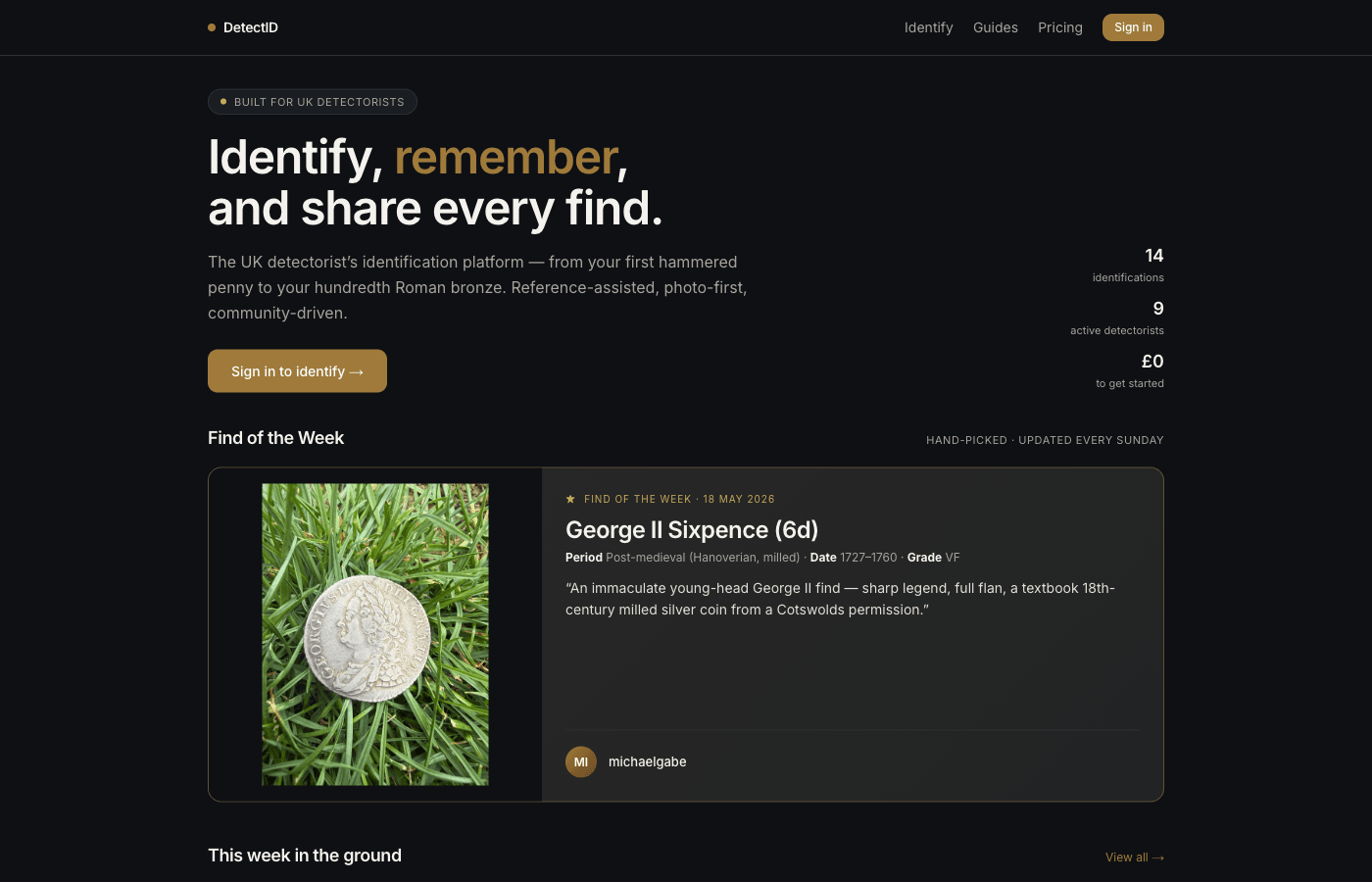
DetectID is an identification platform for UK metal-detecting finds. You upload photos of a find, and within 30 to 60 seconds you get back a detailed identification — ruler, denomination, period, predicted grade, plus a written reasoning chain showing how the verdict was reached. There’s also a collection, public sharing, a personal map, a Rally Mode for organised digs, and a growing community surface.
Who’s it for?
UK metal detectorists. From total beginners with their first detector to club secretaries running rallies and long-time collectors logging their finds. The platform scales with you — useful from your first identification to your thousandth.
How much does it cost?
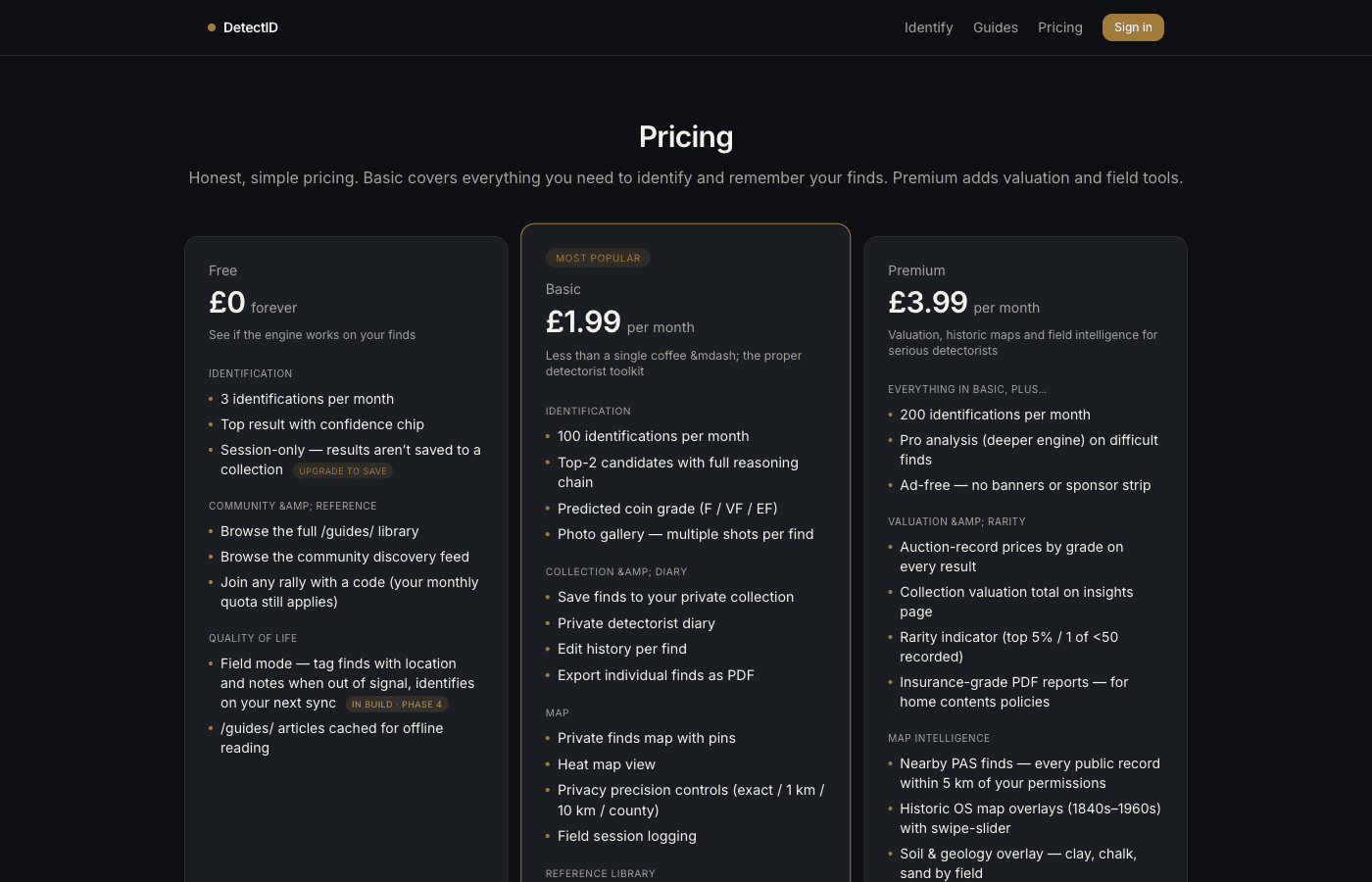
Three plans: Free (3 identifications a month, session-only), Basic (£1.99/month, 100 IDs, full collection), Premium (£9.99/month, 350 IDs, ad-free, future Premium overlays). Top-up packs available for Basic and Premium. Full breakdown at /pricing or in ourplans walkthrough.
Do I need to provide a card to sign up?
No. Free is free. No card collected on sign-up. You only give a card when you actively upgrade to Basic or Premium.
Is there a free trial of Basic or Premium?
We don’t run a formal trial because Free gives you three real identifications a month already — enough to evaluate whether the engine works for your finds. The billing flow is still in development, so paid plans during the early-access period are credited manually on request to admin@detectid.co.uk.
The identification engine
How accurate is it?
On well-photographed UK coins, the engine returns a confident verdict with the right ruler and denomination most of the time. Worn or partial finds are harder — the engine is honest about the limit and surfaces alternatives rather than guessing. Read the result page walkthrough and the reasoning chain post for the full picture.
Does it identify artefacts, not just coins?
Yes, but the coverage is stronger on coins than on artefacts. Brooches, buckles, strap-ends, mounts, tokens are all identifiable. More exotic categories (weights, seal matrices, religious objects) work to varying accuracy depending on the type.
Does it work on non-UK finds?
Yes for many world coinages — broadly modern world, common Roman provincials, post-medieval European silver. We’re strongest on UK series because that’s the methodology focus. World coverage improves over time.
How long does an identification take?
30 to 60 seconds for most finds. Don’t close the tab while it’s running — you’ll see the reasoning chain stream in live.
Can I trust the identification for selling?
Use it as a high-quality first opinion, not as a certified appraisal. For selling at auction or insurance valuation, get a professional opinion (CGS in the UK for coins, an auction house specialist for higher-value pieces). DetectID’s grade is a reasonable approximation, not a certified grade.
Does the engine know about my specific area?
The engine accounts for regional context when you supply it — setting Region to your county helps with regional issues (Welsh marches, Scottish border mints, East Anglian local production). Without a region, identification still works but loses some context.
Why two confidence levels and not five?
Because a granular confidence scale invites over-precision — people start treating a “73% confident” rating as meaningful when it’s not. High and Medium are honest, defensible categories; anything lower the engine declines to commit and asks for better photos. See understanding your identification result.
Devices and browsers
Does it work on iPhone?
Yes — through Safari (or Chrome, Firefox, any modern browser). No app to install. Works on every iPhone made in the last five years or so.
Does it work on Android?
Yes — same thing. Chrome on Android works perfectly.
Is there a native app?
Not yet. The web app works as you’d expect on any modern phone browser; a proper Progressive Web App build with “Add to Home Screen” support is in development. Native apps for the App Store and Play Store are on the long-term roadmap but not a priority — the web app already does what most users need.
Can I use it offline?
Identification itself requires a connection — the engine runs server-side — but Field modelets you capture photos, drop a GPS pin and write notes with no signal at all. Captures stay on your phone in a local queue and auto-upload + identify the moment you’re back on data. Field mode is included on Basic and Premium.
What browsers are supported?
Chrome, Safari, Firefox, Edge — current and recent versions. Internet Explorer is not supported (Microsoft retired it). If something looks broken in your browser, let us know what browser and version.
Privacy
Do you share my data with anyone?
No. Identifications, finds, photos, locations, comments, hearts — none of it is sold or shared with third parties. We use Supabase for database and storage (a UK / EU-friendly Postgres host) and Anthropic for the identification engine. Both are processors operating on our behalf; data stays within DetectID.
What about my photos?
Photos are processed server-side — resized, EXIF stripped (including GPS), stored in our database. We send them to the identification engine to be processed; we don’t share with anyone else.
Can other users see my finds?
Only the finds you specifically mark public. Private finds (the default) are visible to you alone. Full detail in Privacy and location precision.
What about GPS data?
EXIF GPS is stripped at upload — we never use it. If you want a pin on your find, you place it yourself on the location picker and choose a precision (exact, 1 km, 10 km, county, hidden).
Can I delete my data?
Yes — from Settings, request account deletion. Photos and finds are removed within 24 hours. Email is removed from all marketing lists. Some billing records are retained for HMRC compliance.
PAS and the Treasure Act
Does DetectID report finds to the FLO automatically?
No. We never report finds on your behalf. The Treasure Act flag the engine sometimes raises is a suggestion to you, not a notification to anyone.
Should I tell my FLO about every find?
For pre-1700 finds and anything potentially Treasure, yes. Recording with PAS is voluntary for non-Treasure finds; mandatory under the 1996 Act for Treasure. Full guide: Reporting finds to PAS.
Is a single silver coin Treasure?
Almost always no. The Treasure Act requires association (two or more in a group, or alongside other Treasure- eligible items). A solitary silver penny is not automatically Treasure. The engine’s flag is a sanity check — not a determination.
Plans, billing, cancellation
How do I cancel?
The billing flow is still in development — paid plans during early access are credited manually on request. To cancel, email admin@detectid.co.uk and we’ll process it within 24 hours. Once the self-service billing flow ships, a Cancel button will live on the settings page.
What happens to my finds if I cancel?
Your collection stays. Finds become read-only at the Free tier (you can’t add new ones, but old finds stay viewable). Re-subscribe at any time and full features return.
Can I get a refund?
Yes — during the early-access period, refunds are handled manually. Email admin@detectid.co.uk within 14 days of a charge and we’ll refund pro-rata for unused subscription days.
Why is Basic so cheap?
Honest answer: identification cost-per-call has dropped dramatically over the last 18 months, and we wanted a plan that’s genuinely accessible to all detectorists. £1.99/month is less than a coffee. We’ll keep this pricing as long as the cost-per-identification stays manageable.
Why is Premium worth the upgrade?
Three things: 200 IDs vs Basic’s 100, four photos per find vs two, and ad-free. The historic OS and Roman roads overlays are the future Phase-3 Premium hook — not live yet, but coming.
Rallies
Do I need a paid plan to organise a rally?
No. Rally Mode is free to organise. If your rally qualifies (10+ attendees, 20+ finds) you get the Rally Captain perk — 3 months of Premium-equivalent access free.
Can attendees join without an account?
No — attendees need a DetectID account to upload finds. Free is fine for one-day attendance. Sign-up takes 60 seconds.
Can a rally be private?
Yes — set it private at creation. It doesn’t appear on the public /rallies page; only people with the code can join.
Find of the Week
How is it chosen?
Editorially. The DetectID team browses recently-shared public finds each week and picks one. No submissions, no algorithmic ranking. Full criteria inFind of the Week.
Can I opt out of being featured?
Yes — email us or use the find’s contact-finder option. We respect opt-outs.
Community
Is there a forum?
No traditional forum — we deliberately don’t run one. Community happens around individual finds (hearts, comments) and at rallies (live feed, Group ID). Forums tend to fragment into the same handful of debates repeatedly; we’d rather keep the energy find-anchored.
Can I message another detectorist?
Not within DetectID. We don’t run a DM system — DMs are an attack surface for spam and harassment that we can’t moderate at small-team scale. If you want to message someone, find them on Facebook or via their club.
Can I follow other detectorists?
Not yet. Follow mechanics are on the long-term roadmap but the bar is high — we don’t want leaderboard culture creeping in.
Technical
What technology powers DetectID?
Web app on Next.js, hosted on Vercel. Database on Supabase (managed Postgres). Storage on Supabase Storage. Identification engine via Anthropic. UK / EU-friendly infrastructure throughout.
Is the code open source?
Not currently. We’re a small team focused on building rather than maintaining open-source releases. May change in the future.
Where’s the API?
No public API at launch. If you have a specific integration need (a club website that wants to embed Rally Mode finds, for example), email us — we may build a limited API for specific partners.
Sceptic’s questions
How do I know the engine isn’t just making things up?
The reasoning chain is the answer. Every identification comes with the step-by-step diagnostic logic, so you can check each step. If you don’t trust step 3, you can re-photograph and try again. The chain is the antidote to a black-box answer. SeeThe reasoning chain demystified.
What if a knowledgeable detectorist disagrees with the engine?
Sometimes they will. The engine is calibrated against the same methodology a Finds Liaison Officer would apply, but it’s not infallible. The reasoning chain shows the working — you can identify which step the disagreement hinges on, supply better information, and re-identify. Or trust your own experience over the engine’s output when it’s the right call.
What if DetectID disappears?
Honest answer: it could happen. Software companies fold. That’s why we built the CSV export — your data is portable, your collection is yours, you’re not locked in. If the worst happened, you’d have a spreadsheet of your finds plus the original photos in your data export.
Still have a question?
Email admin@detectid.co.ukor check the topic-specific walkthroughs on ourblog. We update this FAQ when patterns emerge in the questions people ask.
Next steps
- Start with the first identification: How to identify your first find.
- Pick a plan: Free, Basic, Premium.
- Privacy detail: Privacy and location precision.
Try DetectID on a real find
Upload a photo and we’ll return a calibrated shortlist with period, denomination, ruler and full reasoning chain.
Identify a find